




Robin Linus, Art & the 1,000 BTC Prius: A Ride to the TABConf 8 BitDevs Barbecue
The audio keeps playing while you browse the site.
Read the transcript11,093 words, every line links to the minute it was said
Ask this episode
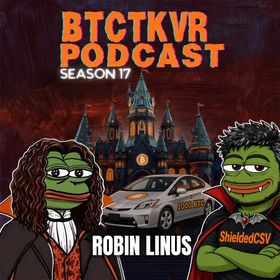
Nobody needs a Lambo when you can have a Prius. That was my opening line, and I meant it. On the last evening of TABConf 8 in Atlanta, Art picked up Robin Linus and me in a white 2011 Toyota Prius with a BITCOIN license plate and drove us to the BitDevs barbecue. This is the car that early bitcoiner Rassah paid 1,000 BTC for, the car that CoinDesk called "the first car ever purchased with bitcoin", and, at today's prices, the most expensive Prius in the world.
It was supposed to be a short clip. "I was gonna be like a very short video," I admitted halfway through the drive, "but it turned out I think I'm gonna post this as a podcast episode." What you get instead is 79 minutes of BitVM's inventor riffing on Shielded CSV, soft fork politics, Spark and the Taproot annex from the back seat, followed by a barbecue where Citrea, Alpen Labs, LayerTwo Labs and a Shielded Bitcoin co-author all ended up in the same frame (or, in one case, very deliberately out of it).
The Car That Cost 1,000 Bitcoin
"This is a 2011 Toyota Prius, which cost 1000 Bitcoin," I told the camera before we had even left the curb. "Crazy, right?" Robin had a better argument for the brand: "Well, it's Japanese and Satoshi was Japanese supposedly. At least in name."
Art told the story from the driver's seat. The buyer was Rassah, "the dev who made Mycelium," who kept the car for years and "would take it to like shows and conferences." After an accident, the plan was to let insurance write it off. Art would not have it: "I talked with him and you know you can't just toss this thing out, it's like historical thing." He and a partner bought it, a third partner paid to restore it, and the group now shares it and brings it to events.
The public record fills in the rest, with a couple of corrections. Rassah is Dmitry Murashchik, who Bitcoinist described as Mycelium's community manager and "the guy who has a Prius with the Bitcoin license plate" (some outlets report the buyer's name as Michael Tozoni). The car is a 2011 model, but the purchase happened in early 2013. On February 14th, 2013, Rassah explained on Bitcointalk that he had borrowed $15,000 to buy bitcoin, waited for the price to reach his "target price of $22," and sold to replace a 14-year-old car with 240,000 miles on it. The Drive reported he met a private seller in Florida who signed the Prius over for 1,000 BTC, roughly $22,000 at the time.
How exactly did the coins move? Art said "he did four payments of 250," but pinning down the transactions is hard "because in those days they intentionally tried to obscure it." They have narrowed it to about ten candidate payments. I could not verify that part independently, so treat it as Art's account.
The car's later life is well documented. According to Scarce.City's auction page, it went to more than 30 Bitcoin events, was damaged in an accident in 2021 (Art remembered it as 2019) and was restored in 2022. In May 2023 it was auctioned at Bitcoin 2023 in Miami, where it collected signatures from Tone Vays, Andreas Antonopoulos, Rassah, Samson Mow and, fittingly for this episode, Paul Sztorc. BitDegree reported a winning bid of 1.2 BTC. Art remembered Scarce.City as well: "that was a third of a share of the car."
Why the First Car Bought With Bitcoin Matters
Everyone knows the pizza. On May 22nd, 2010, Laszlo Hanyecz paid 10,000 BTC for two Papa John's pizzas, and the internet still celebrates it every year. But a pizza is a small, consumable novelty arranged through a forum. A car is different. It is a titled, durable, expensive asset, sold privately between strangers, priced directly in bitcoin and transferred with paperwork that a government recognizes. David Bailey put it bluntly in 2023: "It wasn't just a pizza from Papa Johns, it was substantial. This car was the original Lambo for Bitcoin."
That matters for the oldest argument in Bitcoin. By his own account, Rassah had used bitcoin as his main savings account since June 2011, and when his old car was dying he spent it on something he needed. Robin, a self-described payments maximalist, made the point while we filmed the car: "That car, by the way, is a proof that the people who are saying Bitcoin first needs to be a store of value and then it can become a medium of..." He did not need to finish the sentence. The Prius is the counterexample, a real-world purchase made with bitcoin as money, years before anyone called it digital gold.
Of course, the price chart makes the purchase look absurd in hindsight. "What can you buy with a thousand Bitcoin today, Robin?" I asked. The answer from the front seats was "80 million dollars something," enough that "probably you can buy like the entire street that I grew up in." Art's asking price, by the way, is "a thousand BTC," and he wants it to stay that way: "It's like perma thousand BTC." For Bitcoin Takeover viewers there is a special offer of 999.5 BTC. You are welcome.
Old Wallets, Dream Cars and the Wrong Generation
The ride wandered the way good car conversations do. Robin reminded us how big Mycelium was: "for mobile Mycelium was the thing," while iPhone users mostly ran Blockchain.com. With a 1,000 BTC budget, his dream car turned out to be a Volkswagen Käfer, the Beetle, until I clarified that I meant a thousand bitcoin, not a thousand dollars. Then it was a classic Mercedes-Benz SL: in his eyes, that old Mercedes is "the peak of car design."
One correction belongs here. Robin guessed "this is like the second generation Prius if it's from 2011." It is not. The 2011 model year is the third generation Prius (XW30), sold from 2009 to 2015, which is why the episode carries a small correction card at that moment. And for the record, the odometer read "198,095" miles, which Art reports and which is about 30,000 more than Scarce.City listed in 2023. As someone in the car put it, "a Toyota should run for at least 500,000, so this baby is just getting started."
Shielded CSV and a Million Bitcoin for Payments
What would Robin do with a million bitcoin? "I would invest them all into advertising Bitcoin payments." So he wants to become the new Roger Ver? (If you want the original, my S15 E26 with Roger Ver and Paul's S16 E11 on Roger Ver are still there.)
When I asked how we scale payments, Robin's answer was the paper he co-wrote with Jonas Nick and Liam Eagen, Shielded CSV: Private and Efficient Client-Side Validation. "The Shielded CSV is insanely scalable," he said. The basic protocol handles about 100 transactions per second, aggregation can push that to 4,000, and with optimistic data availability "you can even scale it to I think 100,000 transactions per second. So I think we can put basically all of the world's transactions on Bitcoin." For comparison, he estimated the entire world processes "about 60,000 digital payments per second."
He was gracious toward the big blockers, too. "I'm a payments maximalist, so we are brothers at heart," he said of Roger, and he thinks a block size increase "probably would have been the right choice back then." The real damage of the block size war, in his view, was fragmentation: "We didn't lose them to Bitcoin Cash or BSV. We lost them to Ethereum and then Ethereum lost them to Solana and Tron." Today, the network effects for stablecoins sit with "Tether on Tron," and Robin thinks "gaining network effects is the hard problem," not scaling.
Soft Forks Are About Feelings
I asked Robin what he liked most about TABConf, and he described it as family: "It's very rare that you can just walk into a room and everyone there knows a lot about Bitcoin." The night before, he had dinner with Peter Todd and Paul Sztorc, "two extreme opposites," and the most depressing moment was a betting round on the next soft fork, where "Peter Todd guessing that the Great Consensus Cleanup will come in like 29." (Peter, for his part, was at TABConf to unbox his Zcash ceremony laptop with me.)
Robin is still "very optimistic we're gonna get BIP 448, Template Hash," which he said would let us do "all kinds of cool things with covenants." (Specs: BIP 448 and, for the cleanup, BIP 54.) He would like a SNARK verifier upgrade and maybe Simplicity, and his explanation of how upgrades actually happen was the most cynical thing said all evening: "soft forks are all about feelings and opinions and like points of view, like it's not about technology at all."
His evidence is Taproot (BIP341), which he called "a shitload of complexity for very little gain" that people loved anyway "because the right people pushed for it." The winning formula, he joked, is Greg Maxwell's approval and Pieter Wuille's implementation, which is why he thinks Simplicity has a chance, and why he wants to sell it as the experimental sandbox for post-quantum signatures. For more on how Robin thinks about permissionless development, my S15 E13 with Robin Linus on BitVM and our later {ideal} episode on BitVM optimizations are good companions, along with the BitVM paper itself.
Drivechains, Spark and a Check Engine Light
Back on the road, I read my sponsors and Robin turned one of them into a policy argument. Asked for his favourite, he picked LayerTwo Labs: "Paul is the best. Go to eCash.com, check out drivechains, you can test the software now." Then the real point: "now that Paul forked off, we can finally activate BIP300." In his telling, the only justifiable objection to BIP300 and BIP301 "was that you don't like Paul's Twitter," and he does not entirely disagree: "I love Paul in person but I think his Twitter is a soft fork marketing nightmare." Background reading: S15 E16 with Paul Sztorc, S17 E37 on the eCash launch and my eCash explainer.
Cake Wallet came up next, and Robin called it "the best Monero wallet," then agreed with Seth for Privacy that the missing piece in privacy is UX. (Vik Sharma covered Cake's roadmap on S17 E41.) Spark got the opposite treatment. "Spark is fully custodial," Robin said, "it's just non custodial name only," since you have to trust the server and hardly any wallet implements unilateral exit. His worry is systemic: if regulators stop accepting the non-custodial label, "suddenly you have to KYC half of the ecosystem." Right on cue, the check engine light came on. That is another bitcoin off the price.
The Annex Mafia Arrives at BitDevs
We parked next to another, much cheaper Prius of the same generation, and Robin made "another important service announcement from the annex mafia." His pull request, #36466: policy: make unstructured Taproot annexes standard, would let Bitcoin Core relay transactions that carry data in the Taproot annex, an optional witness field defined in BIP341 that consensus already allows but policy rejects. "You can publish private Bitcoin transactions in the annex and that's why I opened a pull request in Bitcoin Core to make the annex standard," he explained.
"It's just a policy change." It mirrors what Libre Relay already runs, "and even Peter Todd reviewed and he ACKed the pull request." The payoff is Shielded CSV: "private Bitcoin transactions at scale become better with annex standard." His closing plea at the end of the night was even shorter: "Check out the PR, thumbs up, review it, and merge it."
The Privacy Wars Begin
At the barbecue I tried to stage a live battle: Shielded Bitcoin versus Shielded CSV. Present was Misha, Mikhail Komarov, a co-author with Clara Shikhelman and Aleksei Moskvin of Shielded Bitcoin: Private Transfers on the Bitcoin L1, published by [alloc] init in September 2026. Misha prefers to stay off camera, so you will only hear him.
The battle never quite happened, although Robin pointed out that Shielded CSV "is supported by Blockstream right now" and that "Jonas is the first author of the paper." Misha did get the best line about the $44 barbecue ticket, when I asked whether people paid by card or bitcoin: "If we had non-interactive Lightning sure, but we don't have it." Others in line said they had paid with Lightning, two of them via Phoenix.
Then Ekrem Bal walked in. "I'm Ekrem, one of the co-founders of Citrea," he said. "We are building a Bitcoin ZK roll-up and privacy app called Crest." Robin called it "the second coolest product." Ekrem's reply: "There's no second." I declared that "the privacy wars have started on Bitcoin," and somebody offered the winning criterion: "The winner is who stays the longest out of prison." Ekrem had told me more about Citrea and Crest on the S17 E47 TABConf 8 livestream, and Citrea's founder Orkun Kilic was on S15 E18.
Rob Hamilton, Man on the Street
When I handed the microphone to Rob Hamilton, he introduced himself as a "man on the street, Rob Hamilton, reporter for the Bugle, news coming at you live" and immediately did the math: "1,000 Bitcoin, I mean that means each of those wheels must be at least what, like five Bitcoin each." He also reminded everyone that "this is bleeding edge technology back in 2011, this was a hybrid." Rob summed up his own role honestly: "I just started walking with Vlad and now I'm standing here with a microphone and a camera." We agreed he deserves a full episode some day.
This Is Like Bitcoin Uncensored
Somewhere in the steakhouse line, Robin demanded the mic back to discuss "very important political matters," namely Peter Todd's 2029 guess for the Great Consensus Cleanup, "by far the saddest thing in the conference." That is when it hit me. "This is like Bitcoin Uncensored, by the way. This is what they used to do."
About a decade ago, Chris DeRose and Junseth took a camera to Bitcoin conferences and filmed whoever was in the hallway, at the party or in the queue, letting the conversation decide the episode. Nothing here was scheduled. A ride turned into an interview, a parking lot turned into a privacy debate, and a stranger with a microphone became a reporter for the Bugle. If you missed that era, my S15 E44 with Chris DeRose on Bitcoin Uncensored, recorded with Jay Berg, Wayne Vaughan and Paul Sztorc, is the best way to understand it.
Names, Garbled Circuits and zSide
The line was also full of builders. Someone spotted one of the Spaces Protocol people I had interviewed on the livestream, and Robin explained why he bought his own Bitcoin name: a single handle that unifies on-chain, silent payments, Lightning, Ark and Spark addresses. "I just tell you hey I'm Robin at Bitcoin and then you type Robin at Bitcoin into your wallet." Unlike Lightning addresses, which he says "suck" cryptographically because the server can swap the address, Spaces records are verifiable.
Christian from Alpen Labs agreed to a cameo but would not give a mainnet date: "It's not for me to say. Look at our public channels to find out more." Robin brought up SNARK garbling, the garbled-circuit approach to BitVM-style bridges, saying "there were two papers recently." Christian said Alpen's has "a very long name. Internally we call it Talos," and pointed to another one, "we call it Argo MAC," which is Argo MAC: Garbling with Elliptic Curve MACs by Liam Eagen and Ying Tong Lai. (Alpen Labs researcher Liam Eagen has also published Glock: Garbled Locks for Bitcoin.)
Then Paul Sztorc arrived, and the group put the privacy war to him. The only sensible question came up quickly: "What's the criteria for winning?" He described zSide, LayerTwo Labs' Zcash-style sidechain, which "just takes their Rust crate and plugs it in" and hides the sender, the receiver and the amount, running Orchard "updated after that bug they found." (Josh Swihart told me about that bug on S17 E28.) Paul was not sold on formal verification as a cure-all: "I think it's a red herring." Someone else put it more precisely: "You have to be careful what you prove."
Dubai Plates, BitNames and Truthcoin
I walked Paul over to the Prius, a car he had signed in Miami in 2023. Someone remembered that it "was auctioned off" in Miami Beach, and the conversation turned to Dubai, where buyers "pay $10 million for the car and $40 million for the plate." The Prius, at roughly $80 million in bitcoin terms, holds its own. When someone asked how you can put a price on saving the environment, the reply was pure economist: "you could put prices on that."
Paul's next project is BitNames, a naming sidechain, and Truthcoin is close: "I don't know if it will make the October 31st, but it will be very shortly after." On squatting, his answer was to "split into two worlds": ICANN-style names whose existing owners keep their property rights, and new namespaces like ".bit" where anything goes. You get one identity "just plugged into everything" and, if you want, another for whatever else you do. Then dinner called. "Got to go eat some steak," I said, "and maybe watch the battle between Citrea and Alpen."
Closing the Door
Thirteen years after Rassah sold 1,000 BTC for a used hybrid, the car still does what he bought it for: it gets people from A to B. This time the passengers were the creator of BitVM and co-author of Shielded CSV, a podcaster with a Forks magazine and a pile of sponsors, and eventually half of Bitcoin's privacy research scene. As Robin put it when I asked how the ride compared to his morning Waymo: "Infinitely better than the ride that I had this morning in the self-driving car." Thanks to Art for driving, for not crashing on the one-way streets, and for refusing to let a piece of Bitcoin history get scrapped.
Listen to Robin Linus, Art & Friends on Spotify, Apple Podcasts, YouTube, and More
Time stamps:
0:00 Intro 0:45 Riding in the 1,000 BTC Toyota Prius to the TABConf 8 BitDevs barbecue 1:49 The first car bought with bitcoin: Rassah, Mycelium and the Prius backstory 4:01 Mycelium vs Electrum vs Blockchain.com: early Bitcoin mobile wallets 5:03 What 1,000 BTC buys in 2026 (about $83 million) 6:05 Atlanta trivia: Georgia Tech, Coca-Cola, Waymo and BitPay 7:45 How the Prius was paid: four payments of 250 BTC 8:47 Would Art sell the 1,000 BTC car? The "perma 1,000 BTC" price 11:24 Robin Linus's dream car: VW Beetle vs classic Mercedes-Benz SL 14:09 Need for Speed, pink slips and collectible cars as a store of value 15:10 Payments maximalism: BitPay, KYC and why BTCPay Server exists 17:14 Which Prius generation is a 2011? (third gen XW30) 18:21 Buying a car with bitcoin in 2026, shared ownership and Scarce.City 19:28 Mileage check: 198,095 miles on the bitcoin Prius 22:47 Lost on Atlanta's one-way streets in the Bitcoin car 24:23 "Wife changing technology" and dating bitcoiners 26:31 German cars, Ferraris and Porsches 28:12 Walkaround of the 1,000 BTC Prius 30:18 A million BTC for Bitcoin payments marketing and scaling with Shielded CSV 31:20 Visa throughput vs 100,000 transactions per second 32:22 The Prius as proof of medium of exchange, Roger Ver and the block size war 34:29 Network effects, stablecoins and Tether on Tron 36:03 Waymo self-driving car vs the Prius, and tipping culture 37:42 Robin's TABConf highlights: dinner with Peter Todd and Paul Sztorc 39:18 Great Consensus Cleanup in 2029? BIP 448 Template Hash and covenants 40:50 Simplicity, Taproot and how Bitcoin soft forks really get activated 42:26 Simplicity as a path to post-quantum Bitcoin 43:28 Back on the road with Art 45:16 LayerTwo Labs, eCash airdrop and BIP300 drivechains 46:49 Orange Rock, SideShift and the Forks magazine 49:00 A 999.5 BTC discount, Cake Wallet, Monero and privacy UX 51:05 Wasabi in Cake Wallet?
Spark custody and unilateral exits 54:22 Check engine light and Braiins Hashpower 56:35 Arriving at the BitDevs barbecue: Taproot annex PR #36466 58:45 Lexus and Tesla Cybertruck sightings 59:34 A live battle? Shielded Bitcoin vs Shielded CSV 1:01:09 Ekrem Bal of Citrea joins: Crest and the Bitcoin privacy wars 1:02:20 Tom Jones trivia and showing off the 1,000 BTC car 1:03:42 Rob Hamilton, man on the street 1:05:18 Robin on Peter Todd's 2029 prediction: "This is like Bitcoin Uncensored" 1:06:19 Spaces Protocol, the $44 barbecue and paying with Lightning 1:07:58 Bitcoin names: one human-readable handle for every address type 1:10:05 Christian from Alpen Labs: SNARK garbling papers and Argo MAC 1:11:11 Paul Sztorc joins: Alpen vs Citrea, who wins the privacy wars? 1:12:14 zSide, Zcash Orchard and formal verification 1:13:50 Showing Paul Sztorc the Prius: Dubai plates and $80 million 1:15:57 BitNames, Namecoin and the Truthcoin relaunch 1:17:00 How BitNames prevents squatting with ICANN-based names 1:18:36 Goodbye and one last plug for the annex PR
Verify this episode
This is the SHA-256 fingerprint of the MP3 as published here, timestamped in the Bitcoin blockchain with OpenTimestamps. If one byte of the file changes, the fingerprint changes.
- SHA-256
cf6a6dd01d860813d6391f73c07dd460653bf8afc6fec75a898d1f3ad76f7979- Proof
- 2026-10-24_s17_e48_robin_linus_in_the_1000_btc_car_at_bitdevs_in_atlanta_-_23_10_2026_09.45.mp3.ots · all episode hashes (proof)
- Status
- Anchored in Bitcoin block 974,312
How to check it yourself
- Download the MP3 and the proof into the same folder.
- Run
sha256sum 2026-10-24_s17_e48_robin_linus_in_the_1000_btc_car_at_bitdevs_in_atlanta_-_23_10_2026_09.45.mp3(on a Mac:shasum -a 256 2026-10-24_s17_e48_robin_linus_in_the_1000_btc_car_at_bitdevs_in_atlanta_-_23_10_2026_09.45.mp3). The result must match the SHA-256 above. - Install the OpenTimestamps client (
pip install opentimestamps-client) and runots verify 2026-10-24_s17_e48_robin_linus_in_the_1000_btc_car_at_bitdevs_in_atlanta_-_23_10_2026_09.45.mp3.ots. It hashes the MP3 again and checks the proof against your own Bitcoin node, then prints the block and the date the file existed by. Without a node,ots info 2026-10-24_s17_e48_robin_linus_in_the_1000_btc_car_at_bitdevs_in_atlanta_-_23_10_2026_09.45.mp3.otsshows the block height to look up in any block explorer.
Related
S17 E47: Tabconf 8 Livestream with Kevin Loaec, Ekrem Bal, Spaces Protocol & The Bitcoin Pivot
On the last day of TABConf 8, I did another livestream from the hallways of Georgia Tech in Atlanta. The recording was…
S15 E58: Liam Eagen, Robin Linus & Jonas Nick on Shielded CSV, Private Client-Side Validation & the Future of Bitcoin Privacy
Liam Eagen, Robin Linus and Jonas Nick explain Shielded CSV: private client-side validation with ZK proofs, BitVM bridges…
S17 E13: Charlie Spears on Blockspace Media, the Purity Spiral & the Case for Classical Maximalism
Editor’s note: this conversation was streamed live in mid-March 2026, a week after the US switched to daylight saving time (which…

Comments
Comments run on my own server. No ads, no trackers.