




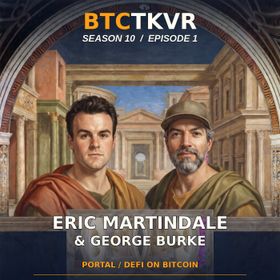
S10 E1: Eric Martindale and George Burke on Portal and DeFi on Bitcoin Layer 3
The audio keeps playing while you browse the site.
Read the transcript13,684 words, every line links to the minute it was said
Ask this episode
Bitcoin and DeFi don't sound like they belong in the same sentence. So naturally, I opened Season 10 with two people trying to put them there. Eric Martindale has been in Bitcoin for more than a decade and co-founded Portal, and George Burke, his co-founder and community builder, had been around for eight years and was organizing the Silicon Valley Bitcoin meetup.
George started the episode by explaining that the meetup was originally put together by Roger Ver and co-organized by Andreas Antonopoulos. Two trigger warning names that maximalists don't like, in the first two minutes. "Say what you want about them." It was a good start, and the rest of the conversation went against the orthodoxy in more useful ways.
Shitcoins Are Affinity Scams
Eric got into payment channels and layers through Ian Grigg's financial cryptography and early Bitcoin Script, and he sees Bitcoin as the base on which old cypherpunk ideas can finally be built "without trusting any third party."
I asked him what Bitcoin maximalism actually means if you build DeFi. His answer was that altcoins are "affinity scams," and that anything novel they do "will be absorbed by Bitcoin." He pointed to Segregated Witness, which was first developed on Elements, a Bitcoin sidechain he also worked on. Bitcoin is "certainly the most perfect money that exists, but it is not perfect."
The reason to build in layers is engineering. "Once you deploy something to a network like this, it's live. Like, you can't take it back." Stuffing everything into layer one makes it look like "a house of cards," so the base layer should stay the final settlement record while other systems do one thing well each.
What a Layer 3 Is
Layer two is clear enough for Eric: "Layer two means off-chain, effectively." The line between two and three is where Portal lives. A layer three, in his definition, is "an explicit contract that runs on top of the layer two" and only involves the counterparties. When you trade, you don't want to publish orders on the blockchain or flood the Lightning Network with announcements. You want to find people with matching orders and settle with them privately. "So really, the layer three for me is primarily the privacy aspect."
Portal builds zero-knowledge proofs around the orders and the order book, and uses them to coordinate atomic swaps. I asked why atomic swaps never took off after all the excitement around them. The gotcha is coordination: both sides need each other's public keys before they can build the transaction. "So that's really the primary value that Portal is adding to the existing atomic swap conversation." The proofs also "conceal the amount that's being traded, except for between the two counterparties."
His motivation is the part I liked most. "I don't want to trade my Bitcoin for shitcoins. I want other people to be able to get rid of their shitcoins in exchange for other people's Bitcoin."
Bitcoin Privacy Really Matters
Eric called it "absolutely abhorrent" that so many uninformed users of other chains are putting their entire financial history into a database meant to last forever. George gave the practical version: connect a MetaMask wallet to a DeFi site and everything in it becomes attached to you. Then he gave the Bitcoin version, buying a burrito from a lunch truck in El Salvador with a coin whose history shows "this guy has at least three BTC in this wallet. Let's go grab them."
I said it was music to my ears. During that bull market, privacy coins were underperforming while Dogecoin and SHIB rallied, and David Hoffman had bought an .eth domain that shows all of his transactions to the world. I also told them I was disappointed by Nick Szabo presenting Visa and Mastercard as layers that would help Bitcoin scale at the Miami conference. Eric's view was more patient: the cypherpunks are "definitely still here and we're still in the fight," but private, scalable zero-knowledge systems only left research land in the past few years, and "We don't want to endanger people's money."
Lazy Users, Busy Governments
In Season 9, Vlad Zamfir told me he felt the larger crypto community was morally responsible for how little privacy governments were planning for their CBDCs, because popular public DeFi made surveillance look normal. I put the idea to my guests.
Eric disagreed with the framing. "I would actually prefer the government get lazy. The reality is quite the opposite, though." Governments have every incentive to expand surveillance and stay quiet about privacy. George's take was that people only notice a threat when it's too late, and he'll keep "shouting from the hilltops: protect yourself from the state." His summary: "Because once your privacy is compromised, you are compromised." That's why Portal aims for "private and secure by default, so even the lowest common denominator, the average swindled shitcoin investor, is not falling victim to this surveillance."
Why Bitcoin Core Developers Burn Out
We talked about developers stepping back from Bitcoin Core. Eric has worked with Matt Corallo and watched Greg Maxwell step away too. The stress of writing code that handles other people's money grows with the price, and he knows of death threats. "So anything we can do to support and encourage people to become Bitcoin Core developers, we've got to do it."
He reminded me he was tweeting "privacy first" during the SegWit debate, and that if you disagree with someone like Luke Dashjr, you have three ways to participate: mine, run a node, or contribute to development.
A Node in a Box
I confessed my own contradiction. I run RaspiBlitz, but I'm not a fan of plug-and-play nodes, and buying one with a pre-synced blockchain is the worst of ideas. Eric agreed that buying someone else's hardware means "You're reintroducing trust into what is supposed to be a trust-minimized or trustless system." His line on software: "If you don't control the software, the software controls you."
I had become paranoid about the Raspberry Pi's CPU, and the RISC-V computers I found cost around $5,000. Eric said truly verifying hardware would mean watching your chip being manufactured, but if enough people demand open hardware, producers will respond. "But people have to care."
At that point I told Eric he reminded me of a younger, more pro-Bitcoin David Chaum. He took it well. "That is a hell of a compliment." He also had a theory about the beard: "the beard is a side effect of the cryptography knowledge, not the other way around."
Portal in 30 Seconds
I should have asked this at the start. Eric's elevator pitch: "Portal is a self-sovereign wallet with an integrated exchange." Monetization could come from software, value-added services or helping people find peers on Lightning. George added a warning about wrapped bitcoin on Ethereum: "If there is a compromise at BitGo, who is the custodian for all wrapped Bitcoin, I shudder to think what would occur." I find it very strange that there was more bitcoin wrapped on Ethereum than on Lightning, Liquid or RSK, and I said so.
When George complimented me as a host, I admitted I'm not technical. When I had Peter Todd on almost two years earlier, I felt like a complete idiot and had to pick up books on cypherpunk culture and history just to keep up. Eric's verdict: "That's exactly right. That's the rabbit hole for you."
What makes this episode worth listening to is hearing DeFi described by people who want it to serve Bitcoin, not the other way around. I still have questions about how much complexity Bitcoiners should accept, but I like anything that goes against the orthodoxy for good reasons. George returned in Season 16 with Chandra Duggirala to talk about Portal making exchanges obsolete. You can also read the full transcript of this episode, browse the Portal and atomic swap topics, or visit the guest pages of Eric Martindale and George Burke.
Listen to Eric Martindale and George Burke on Spotify, Apple Podcasts, and More
Time stamps:
- 00:01:39– The Silicon Valley Bitcoin meet-up (which George Burke currently organizes)
- 00:02:58– DeFi on Bitcoin's layer 2
- 00:06:05– What does Bitcoin maximalism actually mean?
- 00:10:22– Why are layers necessary in Bitcoin development and why was Portal built on Lightning as opposed to Liquid?
- 00:14:20– What is a layer 3 and why is Portal one?
- 00:21:32– How Portal is using layer 3 and the ability to post orders
- 00:40:25– Bitcoin privacy really matters
- 00:50:25– Being lazy with privacy also makes governments lazy with their CBDCs
- 01:04:16– Why it's hard to find Bitcoin Core developers
- 01:07:30– Eric Martindale's "Privacy First" principle
- 01:11:30– Why buying a pre-built node reintroduces trust in a trust-minimized system
- 01:15:45– RISC V boards for Bitcoin nodes
- 01:20:53– Eric Martindale is like a younger David Chaum
- 01:21:30– What is the ELI5 explanation for Portal?
- 01:22:50– What is Portal's monetization model?
Verify this episode
This is the SHA-256 fingerprint of the MP3 as published here, timestamped in the Bitcoin blockchain with OpenTimestamps. If one byte of the file changes, the fingerprint changes.
- SHA-256
d2469c32f569622cc84aadb377cd1c7bcc89a033710a7a801c57de06e3aaa73c- Proof
- 2021-12-29_s10_e1_eric_martindale_and_george_burke_on_portal_and_layer_3_development_on_bitcoin.mp3.ots · all episode hashes (proof)
- Status
- Anchored in Bitcoin block 974,312
- Timestamped
- After release. The episode came out on 29 Dec 2021, but this proof was made on 3 Nov 2026 and anchored in block 974,312, so it proves this exact file existed by 3 Nov 2026, not on the release date.
How to check it yourself
- Download the MP3 and the proof into the same folder.
- Run
sha256sum 2021-12-29_s10_e1_eric_martindale_and_george_burke_on_portal_and_layer_3_development_on_bitcoin.mp3(on a Mac:shasum -a 256 2021-12-29_s10_e1_eric_martindale_and_george_burke_on_portal_and_layer_3_development_on_bitcoin.mp3). The result must match the SHA-256 above. - Install the OpenTimestamps client (
pip install opentimestamps-client) and runots verify 2021-12-29_s10_e1_eric_martindale_and_george_burke_on_portal_and_layer_3_development_on_bitcoin.mp3.ots. It hashes the MP3 again and checks the proof against your own Bitcoin node, then prints the block and the date the file existed by. Without a node,ots info 2021-12-29_s10_e1_eric_martindale_and_george_burke_on_portal_and_layer_3_development_on_bitcoin.mp3.otsshows the block height to look up in any block explorer.
Related
Preview: BTCTKVR Podcast Season 10
The Bitcoin Takeover Podcast keeps on keeping it real with season 10. This time around, we have 16 guests whose topics of…
S16 E25: Chandra Duggirala & George Burke on Portal & Making Exchanges Obsolete
Portal's Chandra Duggirala and George Burke on BitScaler factories, bridge-free cross-chain swaps, a closed-source AI copilot…
S14 E18: Lisa Neigut & Calle on Scaling Bitcoin & Free Open Source Software
During the 10th edition of Hackers Congress at Paralelni Polis (HCPP), I’ve had the pleasure to meet Lisa Neigut and Calle. The…

Comments
Comments run on my own server. No trackers, no tracking cookies.