




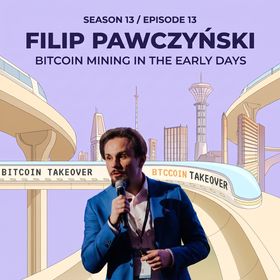
S13 E13: Filip Pawczyński on Bitcoin Mining in the Early Days
The audio keeps playing while you browse the site.
Read the transcript16,737 words, every line links to the minute it was said
Ask this episode
Somewhere in Filip Pawczyński's home sits a small red USB stick with a heat sink on its back. It was sold as a five gigahash miner, a BiFury built on Bitfury chips in 2013, and he still keeps maybe ten of them, which he no longer sells. He held one up to the camera near the end of our conversation and confessed the detail every hardware maker eventually confesses: "The model was named five gigahashes, but it came like two and a half."
I met Filip in Warsaw at Bitcoin FilmFest, which that year overlapped with a libertarian gathering called the Weekend of Capitalism. Wojtek Stopiński of Cryptosteel introduced us, and I immediately wanted to record an episode with him. Here was someone who had mined Bitcoin with video cards, FPGAs and early ASICs long before the industry had public companies and research papers about mining as national security. He was also the chairman of the Polish Bitcoin Association, which he had co-founded in 2013.
The interview runs almost two hours. It is a tour of mining history from plastic baskets full of GPUs to the regulatory exile of Polish crypto companies, told by someone who lived through each phase.
A Poker Room, a Friend and Bitcointalk
I asked how anyone found Bitcoin that early, assuming the answer would be some hacker forum. It started with poker. In college, Filip's friends included former StarCraft and Warcraft players who had switched to online poker because it paid better. One of them found a poker room that accepted Bitcoin and told him about it. "So I was on that other side," he said: he discovered Bitcoin through a use case, the way many people later found it through Silk Road.
The rest of the education happened on Bitcointalk, which he still recommends as an archive. "When you want to see the history of creating Bitcoin in the community, it's there," he said. Filip already ran a small company that could import hardware from China, so his first role in mining was organizing group buys of equipment with friends.
His technical background helped. He had finished his Cisco CCNA while still in school and worked with routers, so he saw miners the way a network engineer would: as hardware that makes the network function.
From Plastic Baskets to the BiFury
The first GPU rigs he built had no frames, because nobody sold mining frames yet. He remembered the cards sitting "in, you know, plastic basket." The effort required, in time, money and research on Bitcointalk, was enormous compared to the value of the coins at the time. It felt more like a laboratory than a business.
Then came the hardware generations in quick succession. Filip described FPGAs, including work with the main European distributor of Spartan chips and units such as the Cairnsmore. He mentioned ASICMiner, and he said the biggest effort of his group went into the first two batches of Avalon miners, which he dated to December 2012 and around June 2013. Then Bitfury and KnCMiner started delivering, and mining became a professional business.
His own product came out of that wave. His company tested Bitfury chips and, from May to December 2013, produced and sold the BiFury USB ASIC miner. The design goal was accessibility: a device anyone with a computer could plug in, drawing what he called "maximum that you are able to get out from the USB 3.0" without a powered hub. He also had a story about how valuable this hardware was. When the first Avalon arrived, they raced to the central DHL warehouse instead of waiting another day for delivery, because a single day of mining was worth around three bitcoins.
What It Cost Back Then
Professional mining today is expensive, and critics often say it shuts out ordinary people. I wanted to know whether the GPU era was really cheaper. Filip estimated that building a rig in 2013 cost "maybe 100 bitcoins, maybe even more," or roughly 10,000 euros. The 2013 altcoin season made it worse: Litecoin mining pushed up the price of graphics cards, and even risers, motherboards and processors became hard to find.
Once FPGAs and ASICs pushed GPUs out of Bitcoin mining, the cards drifted toward altcoins, which kept their prices high.
Chimneys, Kamienicas and Heat
Electricity was the other cost. In the early years, Filip had no special contract with the utility. Instead, he used an architectural quirk. Many old Polish apartment buildings, called kamienica, had ceramic chimney stoves that were later banned for burning wood, and some of those homes were converted to electric heating, which left them with better wiring and a two-zone tariff with different day and night rates. His team rented large flats of around 200 square meters with four-meter ceilings and filled them with miners. Later, in a more professional setup, they rented space on the premises of a power producer so they would not pay for distribution.
Naturally, I asked whether he had ever considered placing miners in people's homes as heaters. A friend from his mining circle had built exactly that in Poland, a project called Silent Miner, which immersed the machine and connected it to the home's hot water and floor heating. Filip was honest about the obstacles. Customers who bought a year or two earlier saw their calculations get worse, and the product needs sales and service people to explain it. "It's just still slow," he said.
Pools, Slush and the End of Solo Mining
I knew Slush Pool started around 2010, so I asked whether he mined solo or in pools. Mostly solo at the start, he said, for maybe two or three months. Then the hashrate jumped and pooling became the only rational choice. He credited Marek Palatinus, Slush, and the team that created the Stratum protocol, and remembered the many competing ways early pools counted shares, some of which gave people a chance to collect more than they should have.
When I asked whether today's industrial mining scares the small miner away, Filip gave a two-sided answer. Decentralized hashrate is "one of the main needs of the Bitcoin network," he said, yet mining also needs to become more professional and sustainable. Publicly traded mining companies in the United States now publish detailed reports, which in his view makes the industry far easier to analyze than in the days of guesswork.
Proof of Work, Politics and Small Nations
When I asked why we need mining at all, Filip turned to Jason Lowery and his Softwar thesis, which he was reading at the time. Proof of work, in his description, represents "real power": real electricity and real hardware, as opposed to the imaginary power of rules enforced by police and courts. I added my own view that proof of stake struggles to be both decentralized and secure, because one coin means one vote.
We then talked about mining politics. In 2023, Texas lawmakers were debating rules for miners, and Filip compared the pressure to earlier state moves against miners, adding "we know what happened next." I asked whether a smaller or developing nation could have legitimate reasons to mine. He pointed to El Salvador, Bitcoin as legal tender and the volcano bonds plan as "very nice idea and very nice use case."
For individuals, his advice was practical. If you have free or cheap electricity and time to maintain a machine, run a loud ASIC and stack sats. If noise matters, GPUs are quieter. Either way, use the heat. I suggested that every Bitcoiner should keep some mining knowledge and hardware around, just in case, and Filip compared it to knowing how to survive before walking into the woods. A BiFury is a lottery ticket at best today. He mentioned that Con Kolivas, the creator of CGMiner, runs a solo mining pool where he recalled a block being found with about 100 gigahashes, and he admitted five gigahashes is "a little bit too small." He promised to bring me one of his sticks in Prague.
Toxic When Needed
My favorite question for OGs is what they would do differently. Filip did not regret the hardware choices. He regretted not knowing enough about sales and people, and not orange-pilling more of those around him. Then he admitted something that surprised me. He had always been more polite than toxic, he said, "and I should to be toxic in some times."
The Polish story explains some of that frustration. The Polish Bitcoin Association started in 2013 to give the local scene a public voice, partly to correct professors and doctors who spread mistakes about Bitcoin in the media. Filip said the community reached the Ministry of Digital Affairs in 2016, with a canon of good practice for crypto businesses, and later founded a chamber of commerce. Then, in his account, the Polish financial regulator put most local crypto companies on a warning list in 2018, banks closed their accounts, and "it was the end of that kind of normal working of the business." He moved to Zug in Switzerland that year and split his time between Zug and Warsaw. "We ended, you know, on exile," he said, before adding that new opportunities were opening again.
In 2023, his projects included Ordinals products, a Polish Lightning wallet startup and Lightning payments in games, inspired by companies like ZBD.
Gold in Civilization II
I should have guessed Filip was a gamer from the StarCraft story, so I asked how a global currency nobody controls fits into games. Filip remembered the economies of Civilization 2 and stressed that building a fun game and building an economy are two different skills. He imagined players owning their characters and assets in a way no company can take away.
I offered a counterpoint from MMORPGs: a pile of gold might be valuable today, but you know nothing about the server's monetary policy, and the developers can inflate it at any time. That is the kind of uncertainty Bitcoin was built to remove. On Ordinals, Filip was optimistic, calling them another path to adoption that uses Bitcoin's open protocol without changing it, while acknowledging that many of us hoped Taproot would bring more nodes and better wallet habits instead of collectibles.
We closed with plans to meet at BTC Prague, a possible Polish edition of my magazine, and a laugh about the French and Spanish editions finding readers in Dakar. If you want to follow Filip, his links are at pawczynski.pl. For more on the history covered here, read my story about almost getting rich mining on SlushPool for a month, my piece on mining centralization FUD, my interview with Nick Hansen of Luxor, the mining archive, or the full transcript of this episode.
Listen to Filip Pawczyński on Spotify, Apple Podcasts, YouTube, and More
Time stamps:
- 00:00:00– Intro
- 00:00:51– Welcome: Filip Pawczyński
- 00:01:55– Meeting at the Warsaw Film Festival
- 00:08:47– How Filip discovered Bitcoin
- 00:13:53– From GPUs to FPGAs
- 00:18:55– Is mining too expensive?
- 00:25:48– Mining from home and electricity prices
- 00:30:57– Miners in people's houses
- 00:34:50– Solo mining or pools?
- 00:38:04– Sponsors: Wasabi Wallet, Cryptosteel, Bumbee, ShopinBit
- 00:42:24– The leap forward in mining hardware
- 00:50:32– Proof of work vs. proof of stake
- 01:00:41– Mining gets political
- 01:05:16– Should smaller nation states mine Bitcoin?
- 01:07:03– How they should do it
- 01:15:22– What Filip would do differently
- 01:19:47– The BiFury miner on camera
- 01:22:19– The Polish Bitcoin Association since 2013
- 01:28:50– Why use a global currency you don't control?
- 01:34:47– In-game economies and gold
- 01:37:21– Bitcoin this year
- 01:42:49– How to follow Filip
- 01:48:31– Sponsors: Wasabi Wallet, Cryptosteel, Bumbee, ShopinBit
Verify this episode
This is the SHA-256 fingerprint of the MP3 as published here, timestamped in the Bitcoin blockchain with OpenTimestamps. If one byte of the file changes, the fingerprint changes.
- SHA-256
50d52d8597543b6aa8bad3eddea38ebffdc7ae08a3697b32048bf22b07af7738- Proof
- 2023-04-20_s13_e13_filip_pawczynski_on_bitcoin_mining_in_the_early_days.mp3.ots · all episode hashes (proof)
- Status
- Anchored in Bitcoin block 974,312
- Timestamped
- After release. The episode came out on 20 Apr 2023, but this proof was made on 3 Nov 2026 and anchored in block 974,312, so it proves this exact file existed by 3 Nov 2026, not on the release date.
How to check it yourself
- Download the MP3 and the proof into the same folder.
- Run
sha256sum 2023-04-20_s13_e13_filip_pawczynski_on_bitcoin_mining_in_the_early_days.mp3(on a Mac:shasum -a 256 2023-04-20_s13_e13_filip_pawczynski_on_bitcoin_mining_in_the_early_days.mp3). The result must match the SHA-256 above. - Install the OpenTimestamps client (
pip install opentimestamps-client) and runots verify 2023-04-20_s13_e13_filip_pawczynski_on_bitcoin_mining_in_the_early_days.mp3.ots. It hashes the MP3 again and checks the proof against your own Bitcoin node, then prints the block and the date the file existed by. Without a node,ots info 2023-04-20_s13_e13_filip_pawczynski_on_bitcoin_mining_in_the_early_days.mp3.otsshows the block height to look up in any block explorer.

Comments
Comments run on my own server. No trackers, no tracking cookies.