




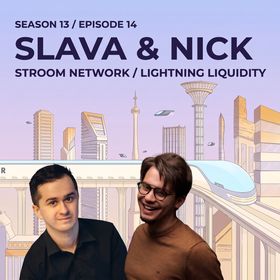
S13 E14: Slava Zhygulin & Nick Schteringard on Stroom Network and Increasing Lightning Liquidity
The audio keeps playing while you browse the site.
Read the transcript10,087 words, every line links to the minute it was said
Ask this episode
Take the Bitcoin that people have already bridged to Ethereum, the coins sitting in cold storage behind wrapped tokens, and use them to open Lightning channels instead. It sounds like heresy to a Bitcoin maximalist, and I said as much at the start: the idea was "rather unorthodox" and, as far as I knew, nobody else had tried it. That was the pitch of Stroom Network in the spring of 2023.
My guests were two Ukrainians. Slava Zhygulin was Stroom's CTO, the one who had to make the design work. Nick Schteringard was the CEO of Boosty Venture Studio, an investor in Stroom and the person who set up the interview. Slava spoke from Ukraine, which, as you will hear near the end, was also the reason Stroom could not send its own team to BTC Prague that June.
What follows is a conversation about yield, federations, routing hubs, cartels, privacy and the user experience problem that nobody in Lightning had solved yet. It is also, in a way I did not plan, a portrait of two very different temperaments: the engineer who refuses to promise anything, and the investor who believes Lightning will eat the world's payments.
Bitcoin Bridged to Ethereum, Sent Back to Lightning
Slava started with a number. Around 400,000 Bitcoin had been bridged to Ethereum the previous year, and roughly 150,000 in the year of our recording. Those coins mostly sat idle in custody while their wrapped versions earned yield in DeFi. Stroom wanted to put them to work on Lightning. In Slava's words, Stroom is "like a bridge combined with the liquid staking derivative approach."
The mechanics were simple to describe. Users would deposit Bitcoin and receive a token on Ethereum, which at the time Stroom called LNBTC. On the Bitcoin side, instead of locking the coins in cold storage the way WBTC does, a federation would use them to fund the channels of one or several large routing hubs, "similar to, I don't know, like LNBig or something like that." Routing fees would flow back to depositors as extra yield on top of whatever they were earning in DeFi.
I suggested it sounded like a staking pool for Lightning. Slava accepted the analogy and then took it apart. DeFi staking pools collect everything in one smart contract address, while Stroom's design used a set of multi-signature addresses controlled by the federation, with a separate address for every depositor. "So it's kind of like staking for Lightning," Slava said, before adding that technically it is "very different."
Why Celsius Was the Point of Reference
Slava kept mentioning Celsius, so I asked why a decentralized project would compare itself with a lender that had just collapsed and taken its customers' money with it. The answer was about the business model, not the morals. Very few products had offered yield on Bitcoin "in the box," and Celsius was the best known. The difference Slava wanted to draw was transparency. With Celsius, "people lost money," and nobody could see what had happened to the coins.
Stroom's promise was a strict one-to-one backing, with redemption to "physical Bitcoins on the Bitcoin chain" always available and supply visible to anyone. Slava was also candid about the limits: the system was meant to be "as decentralized as possible," but "it is not like fully decentralized Bitcoin, of course." I appreciated that sentence more than any roadmap slide.
Nick's Case: Yield Seekers and a Public Good
Nick joined once I teased the only guest who had been quiet so far. "So disclaimer, I'm not in the Stroom core team," Nick began, explaining that Boosty Venture Studio was an investor in Stroom and a studio focused entirely on Lightning. Nick's argument was that many retail users want yield on their Bitcoin whether hardcore Bitcoiners approve or not. If that demand already exists, routing it into Lightning liquidity would at least produce something useful, which Nick called "a public good."
Then Nick went further than I expected, predicting that the stablecoin transfers happening on Tron and Ethereum will eventually migrate to Lightning, because Lightning was designed as a payment network and those chains were not. Nick was openly excited about Taro (now Taproot Assets) and RGB bringing other assets to Lightning, and honest about why: "it's not like a maxi stance, but that's like a stance from reality."
I pushed back gently. Bitcoin still needs on-chain transactions to pay miners as the subsidy halves every 210,000 blocks. My half-joking compromise was that Lightning channel openings could carry a good share of that on-chain demand.
Islands, Roads and Power Laws
My favorite metaphor for Lightning is a map of islands connected by roads. Some islands have one road, some are hubs that everyone wants to connect to. So I asked what Stroom would optimize for. Slava's answer was that hubs compete for users on two things, fees and the robustness of the route, and that the market would decide the shape of the network. His expectation: Lightning will "naturally evolve as a power-law network, much like internet did," with a few large hubs and a long tail of small ones.
The obvious trade-off is privacy, and Slava named it before I did. If a small number of hubs route most payments, those hubs can see a lot. Slava's view was that two parts of the network can coexist: an efficient core and a private periphery, and that a privacy-focused user "can just exclude these big hubs from his route."
Can Big Hubs Form a Cartel?
This was the real disagreement of the episode. I told them about the time BlueWallet charged me roughly what I would have paid on-chain for a Lightning transaction, and asked whether large routing nodes could simply collude and raise fees.
Slava said no, and the reason was permissionless entry. Anyone can open a channel, so if a cartel raised fees, "some people will emerge, which will run their nodes, and they will set up their price lower." The cartel would be left with locked capital and no traffic. In Slava's projection, Lightning fees would stay well below 0.1%, and because capital in a channel can turn over hundreds of times a year, even tiny fees could still pay depositors a 3 to 5% yield.
Nick, the investor, disagreed with Stroom's own CTO. An open market without regulation "tends to monopoly always," in Nick's opinion, and the oldest big nodes would accrue traffic and could raise fees. Nick was relaxed about it, though. Lightning wins on scale, not only on price: "So Bitcoin won't be a payment network, Lightning is." I still want Bitcoin used for payments and blocks full of transactions, so we left that one unresolved.
Inbound Liquidity and the Wallet Question
I asked the question every node runner eventually asks: Stroom can open channels to others, but how do you get others to open channels to you? Slava split the users of any routing hub into three groups: paying customers, merchants and other hubs. Merchants are where Stroom fit naturally, because "Stroom provides them with inbound liquidity, because it's our outbound liquidity." With other hubs, the job is keeping channels balanced, which Slava called "purely algorithmic problem." For paying customers, the plan was partnering with wallets, since wallet software decides who users open channels with.
That led to my suggestion of a Stroom wallet, something like Breeze, Phoenix or Blixt (I had interviewed Hampus Sjöberg about Blixt a few weeks earlier). Slava would not commit. The first design that came to mind was "semi-custodial or custodial," and the federation module that approves hub transactions would have to be reconciled with user-owned channels. "That's definitely not for the nearest year," was the verdict.
At that point I broke character. If I had interviewed an American founder, I said, I would have heard that everything is on the roadmap and coming soon. Instead I got careful engineering caveats, and to me that was how I knew they were honest. "This is also why I like interviewing developers as opposed to marketers. No offense, Nick."
Privacy, Tor and Layer Three
Slava explained private channels as channels that are not advertised to the network and therefore cannot route other people's payments. They hide the final destination from everyone except your direct peer, "but still it is visible on chain." The bigger privacy problem, in Slava's view, is centralization: if a few hubs process 95% of payments, they can reconstruct payment paths, and "we actually know that some companies are already doing that."
I confessed my own fear of exposing a home node's IP address, and my experience that Tor slows things down. Slava knew no better trick than Tor or a VPN, and noted that Stroom's own node ran both clearnet and Tor addresses, acting as a bridge between the two. When I mentioned the Chaumian e-cash projects Fedimint and Cashu, Slava admitted it was the first time hearing about them and asked me to send links after the call. I did promise to.
UX, Implementations and the Best Design Winning
Asked what needed fixing in Lightning, Nick said "User experience, right?" Even with perfect liquidity and a 100% success rate, almost nobody would use it without better wallets. "Because if we fail on that track, nothing else matters, really." Boosty, Nick said, was building Kaminari, a Stripe-like Lightning payment processor for merchants in high-risk businesses, and probably a wallet after that.
Slava blamed the design itself, since payment channels are "not an intuitive thing to deal with," which pushes people to custodial wallets. His hopes were channel factories and Coinpool, the proposal from Gleb Naumenko, whom Slava described as a friend. On implementations, Stroom chose LND for its adoption, its pace of innovation and its Taproot work, while acknowledging that Eclair is more efficient and that a switch might come later.
I then asked about Joseph Poon and Raiden, and corrected myself on air: I meant Plasma. Slava's explanation of why Plasma faded on Ethereum was that the community chose sharding instead, while Bitcoin developers backed Lightning. That gave me the thought I liked most in the episode: the scaling war was won by the best design, not the one with the most money. "And I really like it, the best design wins always," Slava said. I even repeated Andrew Poelstra's joke about rolling up the entire blockchain history into one zero-knowledge proof. Slava's answer was conservative in the right way: "Bitcoin must stay as it is," with full nodes keeping every record.
Explaining Stroom to Grandma
For investors, Slava described Stroom as a "liquid staking derivative for Bitcoin Lightning Network." For non-technical friends, as a protocol that helps Bitcoin scale. Nick tried the grandma version: Stroom is "a professional intermediary" that makes Lightning payments possible in the most efficient way, and in Lightning terms "Stroom is a Lightning Service Provider" funded by ordinary users' capital.
Then the war came into the conversation through a logistics question. I had assumed Stroom would attend BTC Prague. Only Nick could. "Yeah, we actually cannot leave Ukraine," Slava said. Nick was going to the dev day as a sponsor of its Lightning track and would sit on the jury of the startup pitch contest. If you want the backstory of that conference, read my interview with BTC Prague co-organizer Matyáš Kuchař.
Both guests came back to the show later. Nick returned in 2024 to talk about OpenDelta and Runes, and Slava came back in 2025 with Ros to explain how Stroom had evolved into Bitcoin staking. Stroom's current documentation describes a token called strBTC, so LNBTC belongs to this episode's moment in time. For more Lightning node operations, see my Lightning topic page or read the full transcript of this episode.
Listen to Slava Zhygulin & Nick Schteringard on Spotify, Apple Podcasts, YouTube, and More
Time stamps:
- 00:00:00– Intro
- 00:00:52– Welcome: Slava Zhygulin and Nick Schteringard
- 00:01:58– What is Stroom Network?
- 00:04:29– Supplying liquidity to Lightning
- 00:04:49– Stroom vs. WBTC
- 00:08:16– How is it different from DeFi on Ethereum?
- 00:10:12– How does Stroom make money?
- 00:13:08– Nick's role at Stroom
- 00:18:12– On-chain fees and channel openings
- 00:19:25– Stroom's strategy for routing
- 00:23:55– Can anyone run a node?
- 00:24:29– Big players and liquidity pools
- 00:27:57– Traffic on Lightning
- 00:32:16– Opening lots of channels
- 00:36:35– Sponsors: Wasabi Wallet, Cryptosteel, Bumbee, ShopinBit
- 00:40:53– Part two: a Stroom wallet?
- 00:45:00– Privacy on the Lightning Network
- 00:50:13– Fedi and other privacy projects
- 00:51:16– What could be better in Lightning?
- 00:56:19– LND, Eclair, Core Lightning and LDK
- 00:58:54– Lightning's founders and earlier scaling ideas
- 01:04:00– The Liquid sidechain
- 01:06:52– Andrew Poelstra's joke
- 01:08:06– Stroom for non-technical listeners
- 01:12:38– How to follow Stroom
- 01:14:34– Sponsors: Wasabi Wallet, Cryptosteel, Bumbee, ShopinBit
Verify this episode
This is the SHA-256 fingerprint of the MP3 as published here, timestamped in the Bitcoin blockchain with OpenTimestamps. If one byte of the file changes, the fingerprint changes.
- SHA-256
9ec68304aa14b1422c118844c9b677b546527bf81997ad89ae57cf829365fe55- Proof
- 2023-04-27_s13_e14_slava_and_nick_on_stroom_and_lightning_network_liquidity.mp3.ots · all episode hashes (proof)
- Status
- Anchored in Bitcoin block 974,312
- Timestamped
- After release. The episode came out on 27 Apr 2023, but this proof was made on 3 Nov 2026 and anchored in block 974,312, so it proves this exact file existed by 3 Nov 2026, not on the release date.
How to check it yourself
- Download the MP3 and the proof into the same folder.
- Run
sha256sum 2023-04-27_s13_e14_slava_and_nick_on_stroom_and_lightning_network_liquidity.mp3(on a Mac:shasum -a 256 2023-04-27_s13_e14_slava_and_nick_on_stroom_and_lightning_network_liquidity.mp3). The result must match the SHA-256 above. - Install the OpenTimestamps client (
pip install opentimestamps-client) and runots verify 2023-04-27_s13_e14_slava_and_nick_on_stroom_and_lightning_network_liquidity.mp3.ots. It hashes the MP3 again and checks the proof against your own Bitcoin node, then prints the block and the date the file existed by. Without a node,ots info 2023-04-27_s13_e14_slava_and_nick_on_stroom_and_lightning_network_liquidity.mp3.otsshows the block height to look up in any block explorer.
Related
S16 E54: Slava Zhygulin & Ros on Stroom Network, Bitcoin Staking
Slava Zhygulin and Ros of Stroom Network on strBTC, Lightning routing fees, a custodian-held node, and whether yield on Bitcoin…
S15 E35: Nick Schteringard & Konstantin Wünscher on OpenDelta, Runes & the Synthetic Dollar
OpenDelta founders explain USDO, a delta-neutral synthetic dollar on Bitcoin Runes: futures hedging, yield for miners, meme coins…

S17 E36: Yonatan Sompolinsky on Kaspa Covenants, DAGKnight & Coordination Markets
Yonatan Sompolinsky came to Europe for a reason he would only describe on record as a secretive meeting of DAGKnight magicians…

Comments
Comments run on my own server. No trackers, no tracking cookies.