




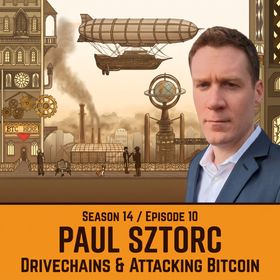
S14 E10: Paul Sztorc on Drivechains & Attacking Bitcoin
The audio keeps playing while you browse the site.
Read the transcript26,694 words, every line links to the minute it was said
Ask this episode
The original plan was a debate. Paul Sztorc would defend drivechains, a critic would attack them, and I would moderate. I spent a week looking for someone willing to take the other side, and I failed. Plenty of people had opinions about BIP300 in August 2023, and many of them were loud on Twitter, but nobody wanted to defend those opinions on camera for two hours.
So we did the next best thing. I collected the tweets, the replies and the chat comments, read them out loud, and let Paul react. This was his third appearance on the Bitcoin Takeover Podcast, after our conversations on the philosophy of drivechains and prediction markets and BIP300 at Baltic Honeybadger 2022, and by now he was the CEO of LayerTwo Labs. Luke Dashjr was preparing the BIP300 pull request, the critics were multiplying, and I introduced myself as "your Bitcoin influencer's influencer," a joke borrowed from Paul's old title.
The episode runs 2 hours and 40 minutes. It covers the two-way peg, miner theft, mining pools, Liquid and Rootstock, Hodlonaut's objections, the SegWit activation saga and, because this is my show, the Water Temple in Ocarina of Time.
The Expert's Expert Under Interrogation
Paul first set the record straight about the nickname. "It was Nick Carter who said that I was the Bitcoin expert's expert," he told me. He never said it about himself; he just stopped fighting it.
Then I played prosecutor with his CV, because the trolls on Twitter had been calling him a spook. A bachelor's in economics, psychology, mathematics and music. Two master's degrees from the Weatherhead School of Management. A stint working on the economic cost of CO2 emissions, a model that, as far as he heard, was used by the White House. If global warming is a scam, as many Bitcoiners on Twitter believe, then surely he had worked on a scam and was now bringing the grift to Bitcoin? Paul laughed and gave credit to Dr. Bill Nordhaus, the climate economist whose modeling work he later left at Yale, who argued for market-based solutions to climate change and made both sides furious.
I added that he once worked as a statistician at Bloq, the company of Jeff Garzik, who coded SegWit2x, and that a company summary I found placed LayerTwo Labs in the Cayman Islands. "I'm not aware of ever having been to any Cayman Islands," Paul replied.
The serious question came from the chat: who put money into LayerTwo Labs' $3 million round? Paul would not disclose names, but he rejected the label. "There is no venture funding," he said. In his description, the money came from OG Bitcoiners who happened to have a lot of it. And no, Roger Ver was not one of them. Paul guessed that Roger, having gone big on Bitcoin Cash, might see a Bitcoin that can copy any altcoin as competition for his own bet.
Altcoins, but Bitcoin Only
Before the tweets, I asked Paul to explain drivechains for the newcomers. A drivechain is a technique for enabling sidechains through a two-way peg. You take the software of an altcoin, Zcash for example, "cut the altcoin out," start it with zero coins, and move BTC into it. Then you use the feature and move the coins back. The layer two is a whole blockchain instead of a channel.
The key, in his view, is that every feature becomes opt-in. Roger wanted large blocks and others did not, so the large blockers could have a large-block sidechain without forcing anyone else to use it. "So ironically, the more people fight BIP300, the more they demonstrate the problem that it solves," he said.
Later he gave me the ATM metaphor. You put a $20 bill in the machine and your checking account is credited with $20; you withdraw elsewhere and get the bill back. The peg is one-to-one, so there is no new token. "It's impossible to scam," he said, because nobody gains or loses value in the move. And when I asked for the explain-it-like-I'm-five version, he settled on "it's altcoins, but Bitcoin only": Ethereum's software without ether, Monero's ring signatures and bulletproofs without XMR.
Reading the Tweets Out Loud
The first tweet came from John Carvalho, a friend of mine, who seemed to imply that if Bitcoin could become any coin, the other coins would disappear. Paul answered with a smartphone analogy: nobody buys a standalone digital camera anymore because the phone has one. I disagreed, partly because I own some very fancy cameras and was streaming from one of them. We settled nothing about photography.
My favorite was Bitcoin Vortex, whose post said there was "absolutely no reason to ever issue altcoins on Bitcoin's L1 chain" and that BIP300 was never happening. It had 419 likes. I had already replied, asking whether he had spent a whole minute researching the topic, and Michael Tidwell of TABConf approved. Paul's verdict: "Every single sentence, every single clause in every sentence is like 180 degrees backwards of the truth." BIP300 puts things on layer two, not layer one. He suspected people were simply virtue signaling to each other, and he described the overall mood with a word he used several times that night: "The cult is very strong."
Can the Miners Steal?
Not every objection was a joke. Someone had told me that miners can steal because the coins in a sidechain could be worth more than the fees miners collect. Paul accepted the premise and tied it to Satoshi's long-run security model, in which fees eventually have to keep the chain moving. "If that doesn't work, then the Drivechain idea should be discarded," he said. His alternative scenario was the status quo: people who want a feature buy an altcoin, and, in his words, "Altcoining is also a great way to get all of your money destroyed."
He also stressed that theft cannot be quick. Withdrawals take months and are identified by a single hash that anyone running the sidechain node can compute, which is why he prefers to call the process confirmation rather than voting. He compared it to a prison where everyone watches the bus pass through "gate after gate after gate after gate."
The strongest critique I read came from Zentoshi: under BIP300, 26% of the hashrate could use the ALARM option to block withdrawals indefinitely, and a government could order a pool like Foundry to do exactly that to a privacy sidechain. Paul conceded the delay part. "He's right that they can be delayed, but delay is better than minus 100%," he said. A frozen withdrawal costs a few months of time value; a theft costs everything. The users who opt into the new feature bear that risk by design.
On government pressure, he said the problem belongs to mining pools, not sidechains, and the fix is making pools trivially easy to leave. I read Matt Corallo's tweet arguing that drivechains make "zero sense" without Stratum V2, Braidpool or P2Pool, and noted it got fewer likes than Vortex. Paul agreed with the goal and said LayerTwo Labs was happy to fund open source pool software, though he thought the situation was "honestly not that bad." Without pools, small miners could not survive the variance of finding a block. When I read Corallo's reply to Jameson Lopp, that small sidechains might be reasonable only if no miner held more than 1 or 2 percent of the hashrate, Paul said he disagreed but respected it, because transactions differ: your coffee money and your life savings do not need the same security.
Liquid, Rootstock and the Xerox Machine
I asked the obvious question: Liquid and Rootstock already exist, Rootstock is merge-mined by a large share of the hashrate, and neither has much traction. Why would drivechains do better?
Paul's first answer was about trust. Both are federated, and he was harsh about Liquid in particular. In his description, it is an 11-of-15 multisig run by people the public does not know, who are not paid for the job, which he called an incentive misalignment. In BIP300, "it's all the same group, the whole time": miners add sidechains, process withdrawals and collect the fees.
His second answer did not convince me, and I told him so. He argued that Rootstock is not an exact copy of Ethereum, while a BIP300 sidechain can run the latest Ethereum full node, which would break the spirit of altcoin holders hoping for a flippening. "No, not really," I said, when he asked whether that made sense. He tried again with a better metaphor: BIP300 is "like an ATM, but it's also like a kind of Xerox machine," a repeatable process for copying any altcoin, while a federation is a one-off event. The argument that finally worked for me was about demand. Issuers will always prefer launching their own token, but buyers might not, if Bitcoin agrees to host even the things most Bitcoiners dislike. "Even if only 2% of the people want to do EVM, those 2% of people go off on their own sidechain," he said. He called it minority rights.
My Vitalik Moment Accusation
I asked what happens if a sidechain becomes dominant and earns more fees than the main chain. Paul thought that was not only fine but likely. He did not believe in a future where people pay hundreds of dollars per transaction, thousands of times a day. His forecast was "two cents to 25 cents or maybe 50 cents" on sidechains and up to a few dollars on the main chain, with fee revenue growing through volume.
I laughed and told him this might be his Vitalik moment, a reference to the claim that the internet of money should not cost more than five cents per transaction. Paul held his ground: almost everything humans buy has fallen in real cost over time, and transacting will not be an exception. He went further, calling it "extremely naive and foolish" to bet everything on Bitcoin being irreplaceable. If something is going to become more popular than Bitcoin, he would rather it be a sidechain that depends on Bitcoin than an altcoin that kills it.
SegWit, ASICBoost and a Small Blocker's Confession
Matthew Haywood of Blockstream was in the chat and accused me of siding too much with Paul, so I read his old notes on drivechain incentives on air. His follow-up argued that miner decisions are "not evil, but not predictable," citing miners blocking SegWit because of ASICBoost.
Paul took the bait with obvious pleasure, because he loves Bitcoin history. He disputes the ASICBoost explanation. If SegWit had really bricked something worth millions, he argued, the hashrate should have dipped when SegWit activated in 2017, and it did not. His alternative story involves bad luck, anger after Scaling Bitcoin 3 in Milan, and a dispute nobody resolved because "both of the two sides just assumed, oh, everyone agrees with us." Then he made a confession that surprised people who still think of drivechains as a big-block plot: "I'm actually in favor of shrinking the layer one block size past, not only from where it is now, four megabytes, but past one megabyte."
His broader point was that you cannot escape assumptions about miners. Every confirmation your wallet counts, and every deposit an exchange credits after three blocks, rests on beliefs about what miners will do.
Hodlonaut and the Shitcoin Question
I saved Hodlonaut for the end because I like him and consider him a friend, but I thought his take was poorly informed. He had written that BIP300 seemed "a great way to introduce enormous amounts of grift, complexity, risk, and shitcoin-esque functionality into the Bitcoin codebase," on top of his general wariness about any change.
Paul pointed out that the sidechains white paper written at Blockstream has a section on issuing assets, and that Liquid lists confidential assets among its use cases. I added my own memories: people doing ICOs on Liquid in 2020, and the fact that tokens on Bitcoin started with colored coins and Counterparty long before Ethereum. Paul also argued that Bitcoiners still judge Ethereum as if it were 2015. Back then, he said, "it really was like a scam," but trial and error has changed it, while Bitcoin's technical elite now "purposefully avoid looking at Ethereum" and risk missing good ideas.
That led to the most provocative line of the night. "In other words, the consensus is the bad guy," Paul said. In his view, requiring everyone to sign off on every idea means very few people will ever bring ideas to Bitcoin, which is why sidechains should exist as places that are experimental by design. He imagined Bitcoin going to zero by 2028 and named the cause he would expect: "I think the indispensable role would be the weird cult." I agreed with parts of it, but defended Bitcoin's immaculate conception and its lack of a benevolent dictator as reasons it became so resilient.
Litecoin as a Testnet With Incentives
I floated an idea some people had suggested: activate BIP300 on Litecoin first, the way SegWit and the first Lightning payment were tried there. Paul said he would help anyone from Litecoin who wanted to do it, though he doubted it would persuade anyone, and admitted he does not wake up excited about that plan. He did like the image of Litecoin suddenly gaining a Zcash sidechain and an EVM. I added that Litecoin's merge-mining with Dogecoin is already a real-world example of a secondary chain paying miners more than the main one, and Paul agreed it was a useful answer to the dominance question.
He also mentioned that the LayerTwo Labs software runs in regtest with play money, so anyone can watch the withdrawal process without trusting his description.
Ocarina of Time Randomizers
The interview ended the way it should, with video games. I had put Paul in my Bitcoin Heads collection, inscribed as inscription 56,535 and also issued on Counterparty, and when I asked him for his card's special attack, he chose "Ocarina of Time randomizers." So I asked whether he had played Tears of the Kingdom. He had not yet, but he remembered the Water Temple well. "That was a clever design for a dungeon," he said, even if it was intimidating.
By then the sun had set in his room and the video had gone dark, which I took as nature telling us to stop. He was about to debate Peter Todd, a debate that became one of the topics of our follow-up episode, S14 E13. His later appearances show how much the strategy changed, from activating drivechains via CUSF to launching eCash with drivechains through a hard fork. For the original design, read Paul's 2015 drivechain post, BIP301, or the full transcript of this episode, and browse the drivechains archive.
Listen to Paul Sztorc on Spotify, Apple Podcasts, YouTube, and More
Time stamps:
- 00:00:00– Intro and sponsors
- 00:01:05– Welcome: Paul Sztorc and the debate that did not happen
- 00:05:10– LayerTwo Labs and the funding round
- 00:08:14– Why Paul sounds more optimistic now
- 00:10:18– Could miners steal more than they earn in fees?
- 00:15:26– What drivechains are and how the two way peg works
- 00:17:40– Sponsor: Wasabi Wallet
- 00:20:48– Bitcoin adoption versus digital gold
- 00:24:54– Soft forks and what old nodes still enforce
- 00:29:04– Why issue altcoins if sidechains exist?
- 00:35:12– Fees and sidechain block space
- 00:40:20– The risks of betting on ossification
- 00:42:40– Sponsor: Cryptosteel
- 00:44:56– Lightning, cold storage and onboarding everyone
- 00:47:29– Ethereum fees versus Bitcoin fees
- 00:51:35– Are drivechains decentralized or permissionless?
- 00:55:41– Rootstock versus drivechains
- 01:01:49– Why would Ethereum users come to Bitcoin sidechains?
- 01:12:03– Explaining drivechains to a five year old
- 01:16:06– Withdrawal votes, delays and state pressure
- 01:16:37– Sponsor: Satodime
- 01:20:13– Making mining pools easier to replace
- 01:26:26– How much control do individual hashers have?
- 01:38:48– SegWit, covert ASICBoost and activation
- 01:44:58– What can nodes do if miners vote no?
- 01:47:02– Demo software and getting the code reviewed
- 01:50:05– What if drivechain opponents split onto another chain?
- 01:56:29– Sponsor: ShopinBit
- 02:03:21– Is even an opt-in tradeoff unacceptable?
- 02:27:03– The regtest demo and a possible Litecoin deployment
- 02:35:43– Nintendo, Zelda and PlayStation
Verify this episode
This is the SHA-256 fingerprint of the MP3 as published here, timestamped in the Bitcoin blockchain with OpenTimestamps. If one byte of the file changes, the fingerprint changes.
- SHA-256
27de61b9adcc8d15c04c03f77e5eef2699eb5a92cfab30fd9d140c57764217c7- Proof
- 2023-08-31_s14_e10_paul_sztorc_on_drivechains__attacking_bitcoin_final.mp3.ots · all episode hashes (proof)
- Status
- Anchored in Bitcoin block 974,312
- Timestamped
- After release. The episode came out on 31 Aug 2023, but this proof was made on 3 Nov 2026 and anchored in block 974,312, so it proves this exact file existed by 3 Nov 2026, not on the release date.
How to check it yourself
- Download the MP3 and the proof into the same folder.
- Run
sha256sum 2023-08-31_s14_e10_paul_sztorc_on_drivechains__attacking_bitcoin_final.mp3(on a Mac:shasum -a 256 2023-08-31_s14_e10_paul_sztorc_on_drivechains__attacking_bitcoin_final.mp3). The result must match the SHA-256 above. - Install the OpenTimestamps client (
pip install opentimestamps-client) and runots verify 2023-08-31_s14_e10_paul_sztorc_on_drivechains__attacking_bitcoin_final.mp3.ots. It hashes the MP3 again and checks the proof against your own Bitcoin node, then prints the block and the date the file existed by. Without a node,ots info 2023-08-31_s14_e10_paul_sztorc_on_drivechains__attacking_bitcoin_final.mp3.otsshows the block height to look up in any block explorer.
Related
S17 E23: Hunter Beast & Mark Karpeles on Quantum-Proofing Bitcoin, Satoshi’s Coins & the Ghost of Mt. Gox
This interview took place on April 29th 2026, at the LayerTwo Labs booth at the Bitcoin Conference in Las Vegas with Hunter…
S17 E22: Jeremy Rubin on CTV, Char & Relentless Building in an Adversarial Environment
Four years. That is how long I have been chasing Jeremy Rubin for an interview, and it took the Bitcoin 2026 conference…
S15 E43: Sergio Demian Lerner on BitVMX, Rootstock & Layer 2s
Sergio Demian Lerner explains BitVMX, a RISC-V take on BitVM that cuts dispute costs to ~$400, plus Rootstock vs. Liquid, blind…

Comments
Comments run on my own server. No trackers, no tracking cookies.