




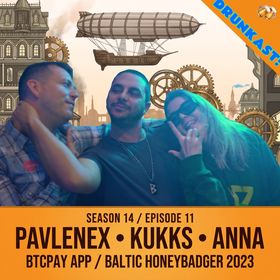
S14 E11: Pavlenex, Kukks & Anna on BTCPay App at Baltic Honeybadger 2023
The audio keeps playing while you browse the site.
Read the transcript6,894 words, every line links to the minute it was said
Ask this episode
Some interviews are planned for weeks. This one happened on the last day of Baltic Honeybadger 2023 in Riga, with gin and tonics on the table (courtesy of Hodl Hodl, as Pavlenex made sure to announce), chairs changing owners every few minutes, and a fresh announcement still echoing from the stage. A few hours earlier, at BTCPay Day, the BTCPay Server crew had told their community that they were going to build a BTCPay App, a native application that would let merchants accept Lightning payments without trusting anyone else's node.
I called it the Bitcoin Takeover Drunkcast, and nobody objected. Around me sat Pavlenex, the product manager of BTCPay Server; Andrew Camilleri, better known as Kukks, the developer behind the Wasabi Wallet integration in BTCPay; and Anna, product manager at Hodl Hodl and the person who did most of the hard work of organizing Baltic Honeybadger. Halfway through, Dennis Reimann from the BTCPay team slipped into Kukks' seat, and at one point I left the frame myself, leaving Pavlenex to joke that he was the last man standing on my own podcast.
It is a short episode, about 40 minutes, but it captures a moment worth remembering: the point when a group of open source developers decided that running a shared Lightning node for everyone was not good enough.
A Lightning Node in Every Pocket
Pavlenex set the scene first. The idea, as he put it, was a mobile app "which will allow any merchant to accept Bitcoin in a non-custodial way." Then he passed the technical part to Kukks, who explained it with a gin and tonic in hand and surprising precision.
The plan was to run LDK, the Lightning Dev Kit maintained by Spiral, inside a brand new native application that could run on phones, desktops and "even potentially on the web." That meant moving away from the full Lightning node implementations BTCPay had relied on for years, LND and c-lightning, so the team could fix the pain points it kept seeing. The architecture Kukks described has a nice division of labor. The BTCPay Server instance can belong to someone else, an ambassador or a friendly host, and it keeps doing what it already does well: generating invoices. The keys and channels live with the merchant. "All the Lightning node stuff will be running on your phone," he said.
This matters because of the uncomfortable trade-off BTCPay operators faced in 2023. You could run a server for many merchants, but if you also ran the Lightning node for them, you were their custodian whether you liked it or not. The app was meant to make the host a helper instead of a bank.
One Year, Hashtag Two Years
Naturally, I asked when. Kukks started confidently and then bargained with himself in real time: one year, maybe two, and finally "So, two weeks. Oh, shit." Anyone who has followed Bitcoin development knows that "two weeks" is the oldest joke in the industry, and it landed exactly as intended.
When Dennis took over the seat, I asked him for his own estimate, to see whether there was consensus among the contributors. His answer: "one year, hashtag two years, maybe." I also asked what his contribution was. He said he showed the app on stage and "made people aware that this is not some kind of vaporware," which made the people around us laugh. Dennis added that this mattered too, and he was right: a demo, however early, is a promise with a face attached to it.
Kukks later framed the timeline more seriously. Two weeks was "probably not an ideal target," but the team would pour five or six years of merchant feedback into the app. Since this was recorded in 2023, everything in this article describes what the team planned at the time, not a finished product.
Why Announce It in Riga?
I wanted to understand the choice of venue. Why reveal a big project at a medium-sized conference in Riga instead of Miami, where the crowd is larger, or BTC Prague? I made it clear that I was not trying to diminish those events. I just wanted the thought process.
Pavlenex said the team loves Riga and that BTCPay Day had been organized there three years in a row. He described the project as "a movement, it's a family, one big family," and explained that big announcements work better inside a circle of people who already use BTCPay Server and will give honest early feedback. Dennis added that a project still far from release is better presented to a closer crowd that can test it early.
Anna described Baltic Honeybadger as a gathering that has been running since 2017, where people who share the same values meet every year. She told me "you get that special vibe," the kind that sends you home with new ideas. Pavlenex added something organizers rarely hear in public: compared to other Bitcoin conferences, Baltic Honeybadger works with much less money, yet improves every year. He liked that it is "very loosely organized," which suits people who work in open source, even if that sometimes means a panel starts late.
The Rehearsal on a Shared Server
The conference itself was a test flight. All the merchants at Baltic Honeybadger 2023 accepted payments with BTCPay through dedicated point of sale terminals. Kukks was candid about the weakness of that setup: the merchants were trusting a central server for everything. "We could have rug-pulled everyone," he said. Anna immediately assured me that this would never happen, and I believe her, but the admission is exactly why the app exists.
Dennis pointed out how far things had moved in one year. At the previous edition, he said, "people could not pay with Lightning." This time, a point of sale device that had been shown to the team at BTCPay Day was working almost flawlessly, the product of a collaboration that started well before the conference.
Pavlenex had been skeptical, and he admitted it. He said the team "really didn't have any problems with actual nodes, liquidity or channels." The real problems were mundane: poor internet on the first day, solved by adding SIM cards to the devices, and some trouble with NFC cards that he attributed to the backend infrastructure, not to Lightning. The best detail was the onboarding. Merchants received devices with the point of sale already installed, typed in an amount, pressed charge, and that was it. "Onboarding took less than three minutes per merchant," he said, and several told him it felt similar to accepting a credit card.
Kukks wanted to keep that simplicity but make it honest. Lightning can look very smooth on the surface while custodial sub-accounts sit underneath, and he called that kind of smoothness "not the correct experience." Pavlenex took it further: "If we are replacing banking system with yet another similar system, then in my opinion that's not the financial freedom that I want to be part of."
Not Lipa, Not LNbits
I had interviewed two projects that seemed to overlap with this plan, so I asked for a comparison. Lipa, the Swiss mobile Lightning service, and LNbits, which I compared on air to WordPress because you can bolt almost any extension onto it.
Both guests were careful with Lipa and said they did not know its internals. Pavlenex's understanding was that it is a centralized company that onboards merchants and handles fiat conversion, and that its users' phones are not nodes. Kukks guessed it ran a backend server with LDK and still required some KYC, but added "we don't know the details." Pavlenex offered a better comparison: Breez and Phoenix, except that BTCPay is "heavily merchant focused," with refunds, NFC card payments and accounting on the roadmap.
As for LNbits, Kukks said they were not trying to compete. Then he described a delightful bit of plumbing: the BTCPay App could act as the Lightning node for a BTCPay store, and a BTCPay plugin could in turn serve as a funding source for an LNbits system. In his words, "you can actually daisy chain all these crazy technologies together." Pavlenex summed up the attitude: in a market this small, "we are all each other's users and we are all each other's competitors."
Roger Ver Was Right?
Then I raised my main worry. The Lightning Network had clearly become more reliable, with payments at the conference succeeding at what I estimated as a rate above 90 percent. But it had also become more centralized. In 2017 and 2018 we talked about a node in every home, and now we pay Lightning service providers a fee for what I called, in my Drunkcast state, a "subatomic swap." Kukks corrected me: submarine swap. I blamed the gin.
Kukks did not dodge the question. "I see that happening actually, it's unfortunate but that's the reality of it," he said. What matters to him is that the network stays interoperable: if the big node you connect to starts censoring payments, you must still be able to open a channel elsewhere and route around it. Then came the line that will annoy some listeners: "Roger Ver was right. We did end up with a hub and spoke model, and that's okay because it's not a centralized problem." His condition was clear, though: "As long as you can circumvent censorship, you're fine."
Pavlenex admitted that the conference setup was itself an example of the problem. To make payments smooth over three days, there was "just one centralized node running" for all the merchants. The team then separated the payments per merchant and did background work to let them hedge against volatility, which Pavlenex credited to Kukks' Prism plugin. The goal for the following year was ambitious: reproduce the same payment success rate with a node on every point of sale terminal. Kukks called that target "insanely perfect."
Data, Finally
One of the most interesting parts of the conversation came near the end, when the developers talked about what the merchant data showed. Because the conference merchants ran on a server whose operator could see every transaction, the team had real usage numbers for the first time. "We've been building a product with no feedback," Kukks said. The data already exposed a design flaw: merchants used the keypad instead of predefined products, so the point of sale graphs stayed empty, and he promised a different dashboard for that use case.
The numbers themselves were the bigger story. Thousands of payments, sometimes several per minute, some of them worth 500 or 600 euros. In 2019, Kukks remembered, a payment above 20 euros would usually fail, and sending 100 sats was something you celebrated. Pavlenex reminded builders to zoom out once in a while, because daily frustration hides real progress. Kukks delivered the summary I would put on a T-shirt: "Lightning sucks, but it's getting better."
Anna Takes the Last Word
I noticed on air that these guys can never do an interview alone. The last time I interviewed Pavlenex and Kukks, in S11 E1, Simon from mempool.space was also in the room. This time, Anna had been sitting quietly to my left, waiting for her turn, so I handed her the closing remarks along with an absurd list of topics, from the conference to the meaning of life.
She ignored the philosophy and went straight for gratitude. "I guess this interview is not supposed to be about Baltic Honeybadger, neither is it supposed to be about me," she said, and gave the credit to the BTCPay crew who set up the merchants. Pavlenex returned the favor, praising the work Hodl Hodl and Anna do behind the scenes, and admitted he had no idea how she stayed sane.
If you missed Baltic Honeybadger 2023, I said it then and I still mean it: you should feel the FOMO. For more on the merchant side of Bitcoin, browse the BTCPay Server and Lightning archives, or read the full transcript of this episode.
Listen to Pavlenex, Kukks & Anna on Spotify, Apple Podcasts, YouTube, and More
Time stamps:
- 00:00:00– Intro and sponsors
- 00:01:14– Welcome to the Drunkcast at Baltic Honeybadger 2023
- 00:02:41– BTCPay Day and the BTCPay App announcement
- 00:03:31– Running LDK inside a native app
- 00:05:15– Anna on the fifth edition of Baltic Honeybadger
- 00:05:51– A multi-year plan
- 00:06:57– Conference merchants on a shared, custodial server
- 00:07:30– A Lightning node on each point of sale
- 00:08:27– Sponsor: Wasabi Wallet
- 00:09:24– Dennis Reimann joins
- 00:10:24– Why launch in Riga and not Miami or Prague?
- 00:12:30– What makes Baltic Honeybadger special
- 00:14:17– Building together: Lightning payments at the conference
- 00:15:25– How the backend works without a shared server
- 00:16:40– Kukks returns: a native point of sale app
- 00:18:22– Sponsor: Cryptosteel
- 00:19:07– Comparison with Lipa
- 00:21:06– Breez, Phoenix and a merchant focus
- 00:22:54– Merchants shouldn't have to think about channels
- 00:24:21– Onboarding merchants in three minutes
- 00:26:01– Not mimicking the banking experience
- 00:27:01– LNbits and cooperation over competition
- 00:28:59– More reliable Lightning, but more centralized?
- 00:30:13– Living with a hub and spoke network
- 00:32:46– Hedging volatility with the Prism plugin
- 00:34:01– Sponsor: Satodime
- 00:34:52– What the merchant data showed
- 00:36:30– Lightning is getting better
- 00:36:58– Anna on Baltic Honeybadger and thanks
- 00:40:01– Sponsor: ShopInBit
Verify this episode
This is the SHA-256 fingerprint of the MP3 as published here, timestamped in the Bitcoin blockchain with OpenTimestamps. If one byte of the file changes, the fingerprint changes.
- SHA-256
646902b87262dd55de5a837eed25e53ded60193769bd256af93760dd8916c5d4- Proof
- 2023-09-07_s14_e11_pavlenex__kukks__anna_on_btcpay_app_at_baltic_honeybadger_2023.mp3.ots · all episode hashes (proof)
- Status
- Anchored in Bitcoin block 974,312
- Timestamped
- After release. The episode came out on 7 Sept 2023, but this proof was made on 3 Nov 2026 and anchored in block 974,312, so it proves this exact file existed by 3 Nov 2026, not on the release date.
How to check it yourself
- Download the MP3 and the proof into the same folder.
- Run
sha256sum 2023-09-07_s14_e11_pavlenex__kukks__anna_on_btcpay_app_at_baltic_honeybadger_2023.mp3(on a Mac:shasum -a 256 2023-09-07_s14_e11_pavlenex__kukks__anna_on_btcpay_app_at_baltic_honeybadger_2023.mp3). The result must match the SHA-256 above. - Install the OpenTimestamps client (
pip install opentimestamps-client) and runots verify 2023-09-07_s14_e11_pavlenex__kukks__anna_on_btcpay_app_at_baltic_honeybadger_2023.mp3.ots. It hashes the MP3 again and checks the proof against your own Bitcoin node, then prints the block and the date the file existed by. Without a node,ots info 2023-09-07_s14_e11_pavlenex__kukks__anna_on_btcpay_app_at_baltic_honeybadger_2023.mp3.otsshows the block height to look up in any block explorer.
Related
S11 E1: Pavlenex & Kukks on BTCPay Server, Soft Simon on Mempool
BTCPay Server and Mempool.space are two of my favorite Bitcoin projects. They’re uncompromisingly open source, they have great…

S16 E31: Andrew Camilleri "Kukks" on Ark, BTCPay Server & Open Source Bitcoin Software
Andrew Camilleri (Kukks), CTO of Ark Labs, on VTXOs, batches, Arkade OS, why Lightning is not the target and why he prefers Ark…

S15 E54: Kruw on Running a Wasabi Coordinator, Blockchain Analysis & the Myths of Bitcoin Privacy
Kruw runs Wasabi's biggest coinjoin coordinator for zero fees. He explains how blockchain analysis works, Samourai's double…

Comments
Comments run on my own server. No trackers, no tracking cookies.