




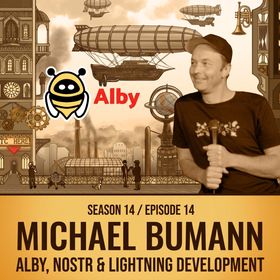
S14 E14: Michael Bumann on Building Alby, Nostr & Lightning Network Development
The audio keeps playing while you browse the site.
Read the transcript8,942 words, every line links to the minute it was said
Ask this episode
"The general idea is to teach the browser Lightning," Michael Bumann told me, and that one sentence is the whole pitch of Alby. Bumi, as everyone calls him, is the creator and lead developer of the extension, and we recorded in Prague at Paralelní Polis, a place he summed up in one line: "Paralelní Polis is the spot to be."
I wanted him on because Alby sits in an odd spot for a Lightning project. It does not ask anyone to adopt a new wallet or a new node. It sits between whatever web application you happen to be using and the Lightning node you already run, or the custodial account you would rather not think about, and tries to make a payment feel like a click. In 2022 that meant Bitcoin people on Nostr, podcast listeners streaming sats, and a growing pile of small web apps that wanted a way to charge for things.
We covered his history with the older Joule extension, the browser-as-platform idea, why he is relaxed about custodial wallets, and what scares him about Lightning's APIs. We also spent a few minutes on the command line, because I could not resist.
From Joule to a Christmas Hackathon
Bumi contributed to Joule in 2018 and 2019, back when a browser extension for Lightning was still a strange thing to want. Alby came later and started at a Fulmo hackathon around Christmas 2021. His own description of the original goal is modest: "My vision was actually that the browser extension should be a small bridge basically between what happens in the browser within the web application and the Lightning nodes."
The part that matters in that sentence is the plural. Alby talks to LND, Core Lightning, Eclair, or a custodial backend, and the user picks. A website asks for a payment through the extension, and the extension passes the request to whatever node sits behind it. Bumi compared the arrangement to MetaMask for Ethereum, which is the comparison most people reach for, and he did not fight it.
His reasoning for why that bridge deserves to exist goes back to what a browser is. "We never had this opportunity to have a platform, a decentralized open platform, that has native payments integrated," he said. Web developers have spent thirty years bolting payments on with credit-card forms and checkout redirects, and the browser itself has no idea what money is. In his version of the picture, "You have your money there. You have your identity there that you bring to applications."
That identity half is easy to overlook. Alby gives you a Lightning address and a NIP-05 identifier, so a Nostr profile can carry both a way to be paid and a human-readable name, and the user never has to hand either to a platform that could later revoke them. Bumi's phrase for the result was short: "you don't have a lock-in."
Spending Budgets and the Zero-Cost Click
The feature I kept poking at was the budget. A website can ask the extension to pay, and you can pre-approve an allowance, so a tip or a few sats for an article does not trigger a confirmation dialog every time. I asked whether that creates a new thing to babysit.
His answer was about psychology more than engineering. "The mental transaction cost needs to go to zero," he said. And he put the reason bluntly: "You do not wake up in the morning and think, today I want to pay." People pay when something on the page is good enough to trigger a reflex, and every extra confirmation window gives the reflex time to die.
I pushed on whether that is a Bitcoiner's instinct at all, since many of us treat every spend as a decision to agonize over. Bumi's side of the argument is that Lightning only matters if it can behave like a click. I added my own gloss from the usual place, which is the number of users who want to do cool things on the internet and do not care much about sound money. On the stream I said we need "to build use cases that cater to these people who don't care necessarily about sound money and they only want to do cool stuff on the Internet." He agreed with the direction, and the budgets are his answer to how a payment can be that frictionless without being reckless.
The same idea runs through the way Alby talks to apps. The web side uses WebLN, a small API that lets a page ask the browser for a payment or an invoice, and the budget is what makes those requests tolerable. On mobile, he pointed to Nostr Wallet Connect and the Podcasting 2.0 world, where Podverse, Fountain and Breez are already letting listeners stream sats. His line for that case: "And then while you're listening to a podcast, you can stream satoshis to the podcaster."
Nostr, Tor and a Banned-in-China Badge
Alby's Nostr side came up because the extension was, at the time, one of the easiest ways to sign in and zap on a Nostr client. Bumi told me the Alby team had even mined a custom vanity npub for René Aaron, one of its members, starting with "npub1getal." I enjoyed that more than I should have.
The darker part of Nostr came up when I asked about censorship. Bumi's reply was the line I laughed at: "That means you do something correct, I guess, right?" He was talking about Nostr apps being banned in China, and the reasoning is the same one Bitcoin people use about hostile regulators.
There is also a privacy angle that I wanted pinned down. The extension runs client-side, and he was precise about what that means: "Once you download it, there is no connection to any server." Nothing phones home. And for people who need a stronger anonymity layer, "The Alby extension works in the Tor browser." He mentioned that Edward Snowden started using Nostr and that feedback came in from him and others using Tor to reach Nostr clients: "When Edward Snowden started using Nostr, we got also quite some feedback from him and others around that, that are using the Tor browser to talk to, or to use, Nostr clients."
There is one practical catch he flagged. In Tor Browser you have to adjust permissions, otherwise the session-based setup drops the connection to your node. Alby also works in Chrome, Firefox, Brave and Edge, so it is not a Tor-only tool.
Custodial as a Phase
I expected resistance when I asked about custodial Lightning addresses, because the community tends to treat any custody as a failure of principle. Bumi does not, and he said so without much hedging: "I very much believe that it's a phase of adoption."
His point is that a new user who has to open channels, fund them, and understand inbound liquidity before receiving a single sat will not become a user at all. A custodial Lightning address lowers the entry cost and lets someone get a feel for the thing before deciding how seriously to take self-custody. He compared the order of operations to ordinary habit formation, and he did it with a joke about procrastination: "I will do it tomorrow. And you will not do it tomorrow."
He also knows how that looks to people who think further out. "for me, sometimes this is like five steps ahead," he said about the long-term scaling debates. He would rather have more people using Lightning this month than win an argument about channel factories. And his plan for growth is deliberately plain: "We need to get us all a Lightning wallet and get it adopted, and from there grow."
For readers who want a self-custodial route, the wallets he named were Phoenix, Breez, Blixt and Zeus. He listed Phoenix among the wallets he recommends: "It's amazing that it's actually possible that you can open the app, you get a new wallet, and you can instantly receive Lightning payments, because they open channels on the fly to you." On the node side he mentioned RTL, ThunderHub and Core Lightning plugins as desktop management options. Lisa Neigut's episode was S12 E8 on running a Core Lightning node from home.
BOLT 12, Rainbows and Unicorns
I asked about scaling, and he declined to take the bait. What he wanted to talk about was whether the implementations can actually interoperate, which is a different problem from capacity. On BOLT 12 he was careful: LNURL currently needs a server somewhere, and BOLT 12 could in principle remove that requirement. But he did not want to promise anything. The line he used was: "When we have BOLT 12, it's all rainbows and unicorns. If that's going to be, we don't know."
That caution sits next to the thing he actually worries about. "One thing that I fear sometimes is that we get a bit too much fragmented," he said. Each Lightning implementation exposes its own API, and each wallet team has to write a different integration for each one. For a project like Alby, whose whole job is to connect applications to nodes, every divergence is an extra adapter to maintain.
His request to the wider developer community was a direct appeal: "Let's try to use common APIs that push for interoperability, because that's ultimately pushing or fostering innovation. It makes it easier for developers. And with that, more ideas can be implemented."
I mentioned that, on my end, LND's command-line feedback is a recurring frustration, and that Pierre Rochard's 2019 desktop wallet had pioneered the idea of integrating a node at the system level, so a user could skip the terminal altogether. Bumi's follow-up was the one that stuck. In his view, "Lightning should be integrated into the operating system directly." The browser extension is a workaround for a world where the OS does not know about Lightning yet.
Ben Arc's episode was S8 E9 on Bowser Wallet, LNBits, and open source development, and Months afterwards I recorded Saunter on Alby and Lightning adoption.
Getting Involved Without Writing Code
Near the end I asked how an ordinary person helps an open source project like this, and he started with a correction to a stereotype: "Typically, people think you have to be kind of a coder to do that. But that's definitely not the case."
His list is concrete. Send feedback. Translate the interface. Report issues when something breaks. The Alby GitHub runs a bounty program for people who do write code, and his advice to developers who are curious about Lightning is that application-layer projects make the best on-ramp: "These projects that are closer to the user, to the application layer, they are a really good start to get into Lightning development also."
The smallest contribution he described is the one most people skip. "You install it, it works for you, you learn how to use it, write it down and explain it to your friends. That's, you know, a super simple contribution to any open source project."
He framed adoption as the actual bottleneck, and I do not think that is wrong. "We could have the best node implementations in the browser or wherever it is, but if nobody's using it, that doesn't make sense."
There was one moment I will mention only because he did. I asked about an event that had been held at Paralelní Polis the week before, and he declined to comment.
Where We Still Disagree
My own view on custodial Lightning is stricter than his. I see a custodial Lightning address as a place where someone else can freeze your balance, and I would rather a newcomer start with a wallet that opens channels for them than with an account on somebody's server. Bumi's argument is that the barrier to entry is the problem and that custody is a temporary price. He says the people who eventually care about self-custody will find their way there, and that insisting on it first means most people never arrive.
I did not come away convinced, and he did not seem to need me to be. We both want Lightning to be usable in a browser tab within a few seconds, and we both want the nodes underneath to stay swappable. Where we part ways is on how much custody to tolerate on the way there, and whether "a phase of adoption" has a way of becoming permanent.
Listen to Michael Bumann on Spotify, Apple Podcasts, YouTube, and More
Time stamps:
- 00:00:00– Intro and Sponsors (Wasabi Wallet, Cryptosteel, ShopinBit, Satodime)
- 00:01:13– Welcome Michael "Bumi" Bumann, Creator of Alby
- 00:01:48– Alby's Start at a Fulmo Hackathon and the Joule Extension
- 00:02:18– What Happened to Joule?
- 00:03:18– Teaching the Browser Lightning
- 00:04:54– Istanbul 2022, Bill Splitting and Nostr Zaps
- 00:05:40– Lightning Addresses and NIP-05
- 00:06:52– Nostr Apps Banned in China
- 00:07:23– Payments Don't Stand on Their Own
- 00:08:30– Nostr's Native Payments
- 00:09:20– Vlad's Lost OG Nostr Keys
- 00:10:49– Number Go Up and the Rabbit Hole
- 00:11:36– Use Cases Beyond Sound Money
- 00:12:20– Your Wallet as Money and Identity
- 00:13:46– Ad: Wasabi Wallet
- 00:14:39– Joule vs. Alby: The Design Difference
- 00:15:32– Budgets and Zero Mental Transaction Cost
- 00:16:29– Core Lightning, Eclair, LNbits and No Lock-In
- 00:17:41– LDK, Greenlight and the Breez SDK
- 00:18:23– Getting Started with Alby
- 00:19:26– Onboarding: On-Chain Swaps and MoonPay
- 00:20:04– Supported Browsers and Safari
- 00:21:12– The WebExtensions Standard
- 00:22:03– Thanks to Paralelní Polis
- 00:23:18– Using Alby with Your Own Node
- 00:24:16– Open Payments Without an Acquirer
- 00:25:29– Ad: Cryptosteel
- 00:26:15– Alby on Mobile and Podcasting 2.0
- 00:27:18– Streaming Sats: Podverse, Fountain and Breez
- 00:27:59– Nostr Wallet Connect
- 00:28:57– Alby in the Tor Browser
- 00:29:55– Feedback from Edward Snowden
- 00:30:26– Can Zaps Be Non-Custodial?
- 00:31:50– Receiving Zaps: Lightning Addresses and LNURL
- 00:33:19– Ad: Satodime
- 00:34:11– Are Custodial Zaps a Dangerous Point of Failure?
- 00:34:39– A Phase of Adoption
- 00:36:06– How Can Lightning Scale?
- 00:37:39– BOLT 12
- 00:39:05– Pragmatic Optimism
- 00:39:37– What Bumi Wants from Lightning: Common APIs
- 00:40:49– Keysend, Zaps and Fragmentation
- 00:41:53– Recommended Lightning Wallets
- 00:42:58– Phoenix vs. Breez
- 00:44:16– Blixt
- 00:44:54– Zeus with Your Own Node or Alby Account
- 00:45:30– LSPs and Instant Channels
- 00:46:03– Desktop: RTL and ThunderHub
- 00:46:50– Command-Line LND and Core Lightning
- 00:47:57– Ad: ShopinBit
- 00:48:44– A Forgotten 2019 Desktop Wallet
- 00:49:05– Lightning in the Operating System
- 00:50:06– How to Contribute to Alby
- 00:51:04– Docs, Guides and Translations
- 00:51:43– A Good Entry Point for Lightning Developers
- 00:53:00– Alby's Roadmap
- 00:54:19– Bounties and Donations
- 00:55:06– Where to Follow Bumi
- 00:55:56– Alby's Vanity npub
- 00:56:24– Goodbye
- 00:56:36– Outro
Verify this episode
This is the SHA-256 fingerprint of the MP3 as published here, timestamped in the Bitcoin blockchain with OpenTimestamps. If one byte of the file changes, the fingerprint changes.
- SHA-256
1ca07b91b121fb66af3d6917bd3da481ec484c6b976b6ef86261de1f485c90c2- Proof
- 2023-10-11_s14_e14_michael_bumann_on_alby_and_lightning_network_development.mp3.ots · all episode hashes (proof)
- Status
- Anchored in Bitcoin block 974,312
- Timestamped
- After release. The episode came out on 11 Oct 2023, but this proof was made on 3 Nov 2026 and anchored in block 974,312, so it proves this exact file existed by 3 Nov 2026, not on the release date.
How to check it yourself
- Download the MP3 and the proof into the same folder.
- Run
sha256sum 2023-10-11_s14_e14_michael_bumann_on_alby_and_lightning_network_development.mp3(on a Mac:shasum -a 256 2023-10-11_s14_e14_michael_bumann_on_alby_and_lightning_network_development.mp3). The result must match the SHA-256 above. - Install the OpenTimestamps client (
pip install opentimestamps-client) and runots verify 2023-10-11_s14_e14_michael_bumann_on_alby_and_lightning_network_development.mp3.ots. It hashes the MP3 again and checks the proof against your own Bitcoin node, then prints the block and the date the file existed by. Without a node,ots info 2023-10-11_s14_e14_michael_bumann_on_alby_and_lightning_network_development.mp3.otsshows the block height to look up in any block explorer.
Related
S16 E9: Saunter on Alby & Lightning Network Adoption
Saunter (@StackingSaunter on Twitter) is a popular European bitcoiner who’s in charge of design and user experience improvements…
The Devil on Your Shoulder: Michael Sutton on Kaspa Covenants, Martti Malmi's Envelope, and Bitcoin's Lowest Since July
Satoshi warned in 2008 that blocks must travel faster than they are made. Kaspa makes ten a second. Three hours live with Michael…
S17 E51: Martti Malmi on Iris, NostrVPN and Freedom Tech
A second talk with Martti Malmi: Iris, NostrVPN, a Nostr bear market, the WordPress story, and an envelope of dollars.

Comments
Comments run on my own server. No trackers, no tracking cookies.