




S15 E38: Crypsi on Crypto Art, Memes & Cypherpunk Culture
The audio keeps playing while you browse the site.
Read the transcript15,021 words, every line links to the minute it was said
Ask this episode
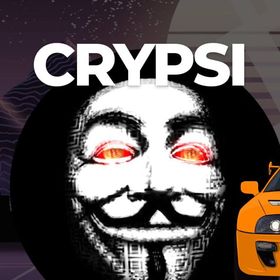
Most of my guests show their faces. Crypsi showed up in a Guy Fawkes mask, muffled audio and all, as the public voice of an anonymous art collective that has been spray-painting Bitcoin into culture since 2014. Behind him: canvases, Pac-Man ghosts, French revolutionary mottos, and a Jamie Dimon portrait that looks like it wants to file a complaint.
Crypsi is not a solo painter with a personal brand. Crypsi is a rumor with spray cans: a small, decentralized group of crypto-anarchist artists who sell physical work (usually in tiny editions) for bitcoin, collect Counterparty rares, and treat memes as a weapon. In this episode we talked about paper wallets hidden inside pictures, why Bitcoin artists get priced out of their own chain, Rare Pepes as living history, and the very cancelable decision to launch a Solana meme coin so young traders might stumble into David Chaum and the Cypherpunk Manifesto.
As I told him up front, this was about "Bitcoin art" and a culture of being anti-establishment without waiting for a marketing budget. He thanked me for finally almost meeting "face to face," mask and all. Whether bitcoiners will forgive the Solana part is another story.
Paper Wallets, Banksy & the First Fork of "Crypto Art"
CPC, as he called the early project, started in 2014 with Bitcoin paper wallets whose public-key QR codes were hidden inside the image itself. Another company, CryptoArt, put the QR in the corner. Crypsi wanted the code woven into the picture. "At that time in 2014 there weren't that many people into Bitcoin," he said, "and there weren't that many people who also like the idea of art as well."
It was a terrible business. It was also the seed. Crypsi spun out as one of three artists inside that CryptoArt world, then drifted into spray-painted graffiti and street work. "We're huge fans of Banksy," he told me, "and in the early days all crypto art was Bitcoin art."
Then came the fork nobody voted on. "Crypto art became kind of co-opted," he said. Bitcoiners hated NFTs for years. Artists still needed to eat. Ethereum paid. Bitcoin NFTs got ignored. "A lot of artists have been driven out of Bitcoin purely because there isn't that much money in it," he explained, which is how you end up with Bitcoin-native creators shipping "shitcoin NFTs" just to stay solvent. Crypsi kept collecting physical Bitcoin art and Counterparty pieces anyway, treating the whole thing as a labor of love rather than a career path with a tidy P&L.
I was proud to spot my old BTC Tkvr magazines on his shelf. He called them almost precious. That is the kind of collector Crypsi is: magazines, canvases, Casascius-adjacent metal, anything that puts Bitcoin in a room instead of a spreadsheet.
Pac-Man, Liberty & Selling Art Without Being a Scammer
Ask him for the iconic Crypsi pictures and he points to the Pac-Man series: Dark Markets, Banks, Currencies. His personal favorite hangs with the French motto of liberty, equality, fraternity. "We think that Bitcoin represents that motto far more than the French government," he said, which is either patriotic heresy or the entire point of the project.
Across roughly ten years they have made about forty pictures, mostly spray paint on canvas, editions of six to ten, plus some sculptures and laser work. Early pieces sold for thirty or forty dollars. They have only ever sold for bitcoin. When I asked the maximalist gotcha (if you want people to spend bitcoin on art, are you a scammer?), he did not flinch. "Certainly not," he said. "It's always been a labor of love." Will a painting outperform bitcoin? "The chances are absolutely not." Should bitcoiners still support Bitcoin artists? Yes, because "art is far more important and powerful than the pen in this day and age" of memes, Instagram and TikTok.
He named names of people doing the unglamorous work: Graffiti as the godfather they keep copying, Fractal Encrypt's historical documentation, Marcus Acuna of Bitcoin roller-coaster fame, a German artist who builds pieces from banknotes. These are not exit-liquidity schemes. They are billboards aimed at Federal Reserve towns, financed by conviction. For a different flavor of Bitcoin storytelling through pictures (animated instead of sprayed), see my chat with Satoshi Sound on the Bitcoin & Friends cartoon reboot.
Where Memes End and Art Begins
I pushed him on definitions. Academically trained artists make memes. Meme makers polish craft until galleries notice. Where is the line?
"Memes [are] definitely a form of art," he answered. "It's probably the most powerful form of art this day and age." A meme can reach millions. Crypsi wants memes with OG roots: privacy, anonymity, resistance to surveillance. My own take, which I floated on air, is that memes are open-source art. Paintings carry intellectual property vibes; remix one and you look like a hack. Memes are templates begging for forks. The Scream and the Mona Lisa get remixed forever, but memes were born for that job.
Asked for the most powerful Bitcoin memes for a complete novice, he reached for the Bitcoin wizard, then for Rare Pepes. Crypsi ignored NFTs for years ("we thought they were a bit scammy"), then fell hard for Counterparty rares. He held up work by Indelible Chase and argued that Rare Pepes are "a historical account of what's happened in crypto." Shitcoin Pepes, Bitcoin Pepes, every saga documented in the base. "For bitcoiners to hate Counterparty [and] hate Rare Pepes," he said later, "it's counterproductive to the whole system."
Privacy, Anonymous & the Mask
I asked about privacy in Bitcoin art and he wandered into Scarce.City, the Bitcoin and Lightning auction house where a lot of this material still trades (including Crypsi collections). Fair enough. Then I pointed at the mask. V for Vendetta. Remember, remember the 5th of November.
That is not cosplay for Cosplay's sake. Crypsi ties Anonymous aesthetics to Bitcoin's original pitch: independence from governments and banks, the 99% pushing back while mega-wealth concentrates. "We've always been proponents of Anonymous as well as Bitcoin," he said, "and there's a lot of great artists [who] use the Anonymous theme because we think it fits perfectly with the Bitcoin ethos."
If you want the mailing-list version of that ethos from someone who was literally there when Satoshi's paper landed, my conversation with Perry E. Metzger on cypherpunk culture pairs well with this one. Crypsi is the spray-paint wing of the same argument.
Ordinals, Fake Rares & Not Damaging the Chain
We went through the loop that never dies: Counterparty, Spells of Genesis, colored coins, Namecoin, Ethereum as the off-ramp for non-financial experiments, then Ordinals bringing JPEGs home to Bitcoin nodes forever. I mentioned my Bitcoin Heads on Counterparty and as inscriptions, and even a David Bailey face I inscribed when fees were still friendly. Crypsi's stance is careful. They made a few early Ordinals. They have friends in stamps. They still ship Counterparty work for Fake Rares, W-Jacks and other community collections. But if something feels like it damages Bitcoin, they step back. "We don't want to create art that damages Bitcoin in any way," he said.
He also gave Fake Scrilla (Rare Skrilla / Scrilla Ventura) his flowers as one of the most famous Bitcoin artists alive, the remix engine behind a Pepe style you recognize instantly. One of those designs even landed on a Bitcoin Takeover magazine cover Crypsi still owns. For the Ordinals protocol side of this cultural fight, Casey Rodarmor on inscriptions and Bitcoin culture is the companion episode.
Copyright lawyers? Capcom and Pac-Man? Crypsi's answer was half legal, half cypherpunk: it is a Bitcoin Pac-Man, different enough, and also the collective pretends not to exist. About seven part-timers in seven countries. No single point of failure. Anarchist art logistics.
Banks, BlackRock & Be Careful What You Ask For
Behind Crypsi hangs Jamie Dimon. The banks ignored Bitcoin, then private clients of BlackRock started buying through ETFs, and Crypsi expects real bank FOMO closer to the next cycle. I mourned the path from replacing the dollar to begging corporations for a 1% balance-sheet allocation.
His line was sharp: "It's definitely a case of be careful what you asked for." Bitcoin asked for bank involvement and is getting it. Roughly 92 or 93 percent of supply was already out before banks cared, so institutions hunting 20 or 30 percent will pay "an absolute fortune."
Bitcoin wins either way. Whether we win, if privacy dies and KYC becomes the default, is a different question. That CBDC-flavored victory is not the one Crypsi is painting for.
The Solana Meme Coin That Lost Them Friends
Here is the part that will make half the audience close the tab. Crypsi launched a Solana meme coin (Crypsi coin) as a Trojan horse for cypherpunk homework. Telegram quizzes on David Chaum, John Gilmore, Roger Ver, Bruce Schneier, OG bitcoiners. "It's a kind of meme coin for bitcoiners," he said. Bitcoin fans hate them for launching it. Meme coiners hate them for calling most meme coins scammy. Stuck in the middle, they are giving supply away over five years, not-for-profit, and using interest to fund anti-central-bank art.
The spark was a friend, Dart Farms, whose Book of Meme token went insane. The congratulations reply was roughly: it is great to fuck the system a bit. Alarm bells. Mission accepted. Solana because that is where the attention was; they looked at BRC-20 and decided preaching Bitcoin ideology might work better off Bitcoin so they are not bloating the chain they claim to love. "If you're preaching Bitcoin to a Bitcoin community then you're not really doing any good," he argued. "If you're preaching the cypherpunk ideology to meme [coiners] who have no idea what crypto was in the first place, we think that does a little bit more good."
I corrected his "cipher funk" slip to cypherpunk on air. He laughed it off as dystopian-art vocabulary bleed. I also asked the hard version of why not on Bitcoin: don't bitcoiners need the reminder too, now that bankers are some of the biggest holders? He agreed the roots are getting lost, promised education without shilling buys on my show, and floated a Bristol Bitcoin art exhibition funded with SOL from the pre-sale. Physical Counterparty rares and Bitcoin art on the walls, not Solana NFTs. Their main Crypsi art Twitter account jumped from roughly 1,800 to 2,400 followers in six weeks after the meme pivot, which is either proof of concept or proof that attention is trashy. Probably both.
Live, he offered 21 Crypsi tokens (about fifty cents at the time) to listeners who posted a Solana address, part of a wider plan to give away a million of twenty-one million over five years. Flutter, not investment. His words: "definitely not an investment."
On maximalism getting "a bit out of hand," he reminded me that early bitcoiners traded other coins, Dogecoin included, and that Litecoin and Monero still make sense as test beds and privacy labs. Everything else eats itself every cycle. Bitcoin has to survive for any of it to matter. For the scaling-maximalist counterpoint (do the weird stuff on Bitcoin via sidechains instead of forever spinning new L1s), Paul Sztorc's episode where he cannot say Drivechains is still the funniest manifesto in my archive.
Print Your Own Wallet, Hate Coinbase Custody
Near the end we got tactile again: Casascius coins, TGX physical Bitcoins, laminated paper wallets from 2014, printers that remember what you printed, air-gapped machines that barely exist anymore. "Anyone using a Coinbase wallet or anything like that is just an idiot," he said, which is not subtle and does not need to be. Sovereignty is the product. Art is the advertising.
His closing pitch was not the token. It was Scarce.City, Rare Pepes, Counterparty history, shout-outs to Rebel Money Art and Flo Montoya's Friday Spaces, and the stubborn claim that Bitcoin culture needs painters as much as it needs protocol engineers. I joked that episodes like this get me cancelled. I am used to it. Spreading history through unconventional memes is still, somehow, a Bitcoin story.
Listen to Crypsi on Spotify, Apple Podcasts, YouTube, and More
Time stamps:
00:01:39 - Bitcoin Art Collective's Origin
00:03:19 - Evolution of Crypto Art
00:12:21 - Role of Art in Bitcoin Revolution
00:13:28 - Intersection of Memes and Art
00:18:15 - Importance of Privacy in Bitcoin Art
00:25:37 - Debate on Bitcoin Art and NFTs
00:27:06 - Bitcoin's Evolution
00:28:07 - Art and Bitcoin
00:29:23 - Challenges in Bitcoin Art
00:30:21 - Crypto Art Movement
00:35:22 - Art in Crypto Community
00:38:38 - NFTs and Bitcoin
00:42:10 - Bitcoin Adoption and Challenges
00:44:07 - Crypto Art Tokens
00:51:39 - Bitcoin Maximalism and Multi-Chain
00:52:28 - The multichain future
00:53:10 - The meme coin collective
00:55:37 - Exploring alternative chains
00:59:14 - The role of crypto art in promoting ideas
01:00:01 - Educating about Bitcoin's original ideals
01:04:54 - Cypherpunk ideology and Bitcoin's mission
01:09:27 - Promotion of Bitcoin-related products
01:15:39 - Embracing sovereignty and freedom
01:16:32 - The history of securing Bitcoin
01:17:35 - Balancing security and accessibility
01:19:17 - The evolving landscape of crypto art
01:20:18 - The rise of meme coins and NFTs
01:25:22 - Challenges with the younger generation
01:28:17 - The distribution of crypto tokens
01:31:18 - Promoting Bitcoin art and history
01:32:25 - Parting thoughts
Verify this episode
This is the SHA-256 fingerprint of the MP3 as published here, timestamped in the Bitcoin blockchain with OpenTimestamps. If one byte of the file changes, the fingerprint changes.
- SHA-256
95de8f394be5d42b453945794d003ca8949ff7cabfa8b34b125fedd7019cf100- Proof
- 2024-05-30_s15_e38_crypsi_on_crypto_art_cypherpunk_culture.mp3.ots · all episode hashes (proof)
- Status
- Anchored in Bitcoin block 974,312
How to check it yourself
- Download the MP3 and the proof into the same folder.
- Run
sha256sum 2024-05-30_s15_e38_crypsi_on_crypto_art_cypherpunk_culture.mp3(on a Mac:shasum -a 256 2024-05-30_s15_e38_crypsi_on_crypto_art_cypherpunk_culture.mp3). The result must match the SHA-256 above. - Install the OpenTimestamps client (
pip install opentimestamps-client) and runots verify 2024-05-30_s15_e38_crypsi_on_crypto_art_cypherpunk_culture.mp3.ots. It hashes the MP3 again and checks the proof against your own Bitcoin node, then prints the block and the date the file existed by. Without a node,ots info 2024-05-30_s15_e38_crypsi_on_crypto_art_cypherpunk_culture.mp3.otsshows the block height to look up in any block explorer.
Related
S17 E45: Talking Tari & Privacy with Naveen Jain, Mr. Fox & Marguerite de Courcelle
There are projects in this space that are famous for what they shipped. Tari used to be famous for what it has…
S13 E3: Casey Rodarmor on Ordinals, Inscriptions & Bitcoin Culture
Ordinal inscriptions are all the rage. They obsoleted the concept of NFTs by offering artists a permanent way to display their…
Les NFTs Bitcoin sur Counterparty (et Comment Obtenir Ou Créer votre Premier NFT)
Omniprésents sur l’ensemble des médias et pourtant largement incompris, les NFT sont les sujets de fascination et (surtout) de…

Comments
Comments run on my own server. No ads, no trackers.