




S10 E11: Rare Scrilla on DJPEPE, Music NFTs & Why Counterparty Is King
The audio keeps playing while you browse the site.
Read the transcript16,662 words, every line links to the minute it was said
Ask this episode
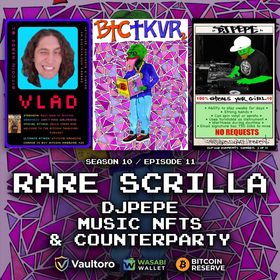
I introduced my guest by reading a trading card. Strengths: can stay awake for days, strong hands, spins vinyl or Serato, uses the turntable as an instrument. Weaknesses: worthless during daytime, an email signature with 750 links to mixes. Special trait: a 100% chance to steal your girl. That is DJPEPE, the Rare Pepe card created in October 2016 and issued at Bitcoin block 434,102, and the artist who drew it was back on my show for the second time.
The first time, back in Season 3, my guest went by JScrilla, talking about Sound Money, a Bitcoin hip-hop album, and about releasing it as a Counterparty token at a moment when almost nobody cared about NFTs. By the time of this recording, a DJPEPE was selling for around $9,000, and the name had become Rare Scrilla. Scrilla was also on "daddy duty," which explains a couple of interruptions you will hear.
This was the last regular episode of my Counterparty season, and it became a long conversation about music NFTs, sub-assets, the war between Bitcoin maximalists and Pepe traders, and why a card game on a "pretty dumb" smart contract from 2014 may outlive Ethereum.
"I Literally Manage DJPEPE"
I made the mistake of saying that more people know my guest as DJPEPE. Rare Scrilla corrected me immediately. "DJPEPE is a memetic creation in the blockchain," Scrilla said, and the human only manages it. "I like to make sure that I'm not DJPEPE. I literally manage DJPEPE." A human cannot live in a blockchain, but DJPEPE, apparently, lives in the mempool and DJs for everyone stuck there, which in a week of 13-hour Counterparty confirmations meant the parties were popping.
The card's subject is DJ Qbert, Scrilla's favorite scratch DJ and one of the Skratch Piklz. "I took his image, his likeness, and frogged him out," Scrilla said. When Qbert entered the NFT space, Scrilla sent him a DJPEPE, and the two later released FAKEDJPEPE on the card's five-year anniversary. Qbert wrote all of the card's text, which is how the world got lines like "allows you to scratch in space" and "levitates your panties." The FAKEDJPEPE was trading around $2,300 that day. "Yeah, it's pretty nuts," Scrilla agreed.
There was even a multiverse theory. Every Bitcoin fork technically carries a copy of DJPEPE, but on those chains, according to an article Scrilla wrote, "it just wouldn't be as alpha. It'd be like a beta version of DJPEPE." I offered the Spider-Man version: there is only one Peter Parker who gets Mary Jane.
Sub-Assets and an Album With Legs
Counterparty's sub-assets let a token owner issue new tokens under an existing name, and Rare Scrilla used them to keep an independent album alive. The first 21 copies of the Sound Money vinyl were hand-drawn with marker, photographed and issued as DJPEPE.SOUNDMONEY sub-assets, so each NFT points to a physical one-of-one. "Literally, dude, there's, like, you know, maybe 200 people in the world that, like, even care about it like that," Scrilla said of a hip-hop album about Bitcoin. Still, the NFTs gave the project "a life that it wouldn't have had without, like, Bitcoin NFTs and the community," with 18 months of legs.
The comparison with the mainstream music industry was brutal. Scrilla called 2021 "literally my biggest, like, year of music of all time," including artwork and half the production on Benny the Butcher's Pyrex Picasso and an album with Rome Streetz and Ankhlejohn. Those projects had legs for a month or so.
Then came the lesson on asset ownership, a Counterparty feature Scrilla says you do not find on Ethereum. The token issuer owns the asset name, while collectors hold the tokens, so a card can have "two lives." The example was HOMERPEPE, a one-of-one whose owner issued HOMERPEPE.Sock at the 2019 Rare Pepe auction, long before Uniswap's SOCKS token. Scrilla turned this into brands: DJPEPE for the DJ element of hip-hop, and PEPEONE for graffiti, through which the graffiti legend CES ONE dropped a free black-book Pepe to holders. All graffiti gets wiped at some point, "but still, you have it on the blockchain."
How to Put a Song on Counterparty
I wanted the practical answer: how do you attach audio to a Counterparty token? Since the Fake Rares arrived, Scrilla explained, people have been experimenting with enhanced assets. Files go to Arweave, described as "a decentralized storage thing," or to Imgur or YouTube, and a JSON file links the media to the token so explorers can show the image and the MP3 together. The original Rare Pepes were limited to a few megabytes, while Fake Rares carry large files and even web pages.
My point was that a Counterparty token survives even if the hosting disappears, because the issuer can update the description and point to a new location. Scrilla added that this is exactly what fries the minds of people who arrive from Ethereum: asset ownership, description changes, cheap multi-sends, "the amount of things you can do with a smart contract that is pretty dumb, that has existed for, you know, almost eight years, with barely being maintained."
The ideas got wilder from there. A song could evolve through sub-assets, from the first notes to the rough mix to the master. I suggested releasing stems, one token per instrument, so collectors make their own mix. Scrilla liked it: if Madlib released stems, "I would jump on that." The obstacle is that Counterparty has no foundation and no development fund. "And it's like punk rock," Scrilla said. "It's, like, the tortoise in the race."
Flagged on OpenSea, DMCA-Proof on Bitcoin
Rare Scrilla had just minted a daily audio-reactive series on a personal Rarible contract. All the pieces showed up on Rarible, but one of them silently vanished from OpenSea, without a notice. "And these are problems you don't have with Bitcoin," Scrilla said. The bigger example was Robness, who put the CC0 Bitcoin logo up for sale on SuperRare and got banned from the platform. "With Bitcoin, it's, like, DMCA-proof, pretty much."
CryptoPunks, Pepe Cash and the Maximalists
I came in with a strong opinion. Much of what sells on Ethereum, starting with CryptoPunks, felt computer-generated and soulless to me, while Rare Pepe and Spells of Genesis carry a human touch. Scrilla was more generous. Having hosted the Art on the Blockchain podcast, which interviewed Larva Labs' Matt Hall in 2017, Scrilla gave CryptoPunks credit for history and for being a catalyst for the whole NFT space, and praised Matt Kane's Gazers as "the most brilliant blockchain project I've seen." Most of what followed, though, Scrilla dismissed as "straight, like, influencer project-driven bullshit."
We disagreed more interestingly about inflation. I argued that Counterparty tokens do not inflate BTC, they only compete for block space and might help pay miners as the subsidy shrinks. "It would be quite ironic if we ended up trading frog JPEGs to secure the Bitcoin network," I said, and I would still prefer that to touching the security model. Scrilla pointed to Pepe Cash, which in Scrilla's account reached "a $100 million market cap" in 2017-18, as proof that people did trade Bitcoin for currencies on Bitcoin. In the end Scrilla conceded that inflation was the wrong word: "you can create more value assets on Bitcoin."
The history of the backlash is personal. In 2017 and 2018 especially, Bitcoin maximalists mocked Counterparty users for "spamming the blockchain" with Pepes, and Ethereum investors noticed what the Pepe crowd had built. "Ethereum basically saw what we did," Scrilla said, and the crypto art market moved there for years. Scrilla even put Bitcoin art on Ethereum during that period: "I was putting Bitcoin propaganda on the Ethereum chain."
When I told the story of Giacomo Zucco going from defining Bitcoin maximalism to wearing a unicorn T-shirt on stage, Scrilla's position was balanced: "I'm also a Bitcoin maximalist," but you can experiment "over here, where the rabbit is, and, you know, be safe with the turtle."
Troll Boxes and Bear Markets
The Poloniex troll box gets a bad reputation, but for Rare Scrilla it was "probably the greatest education I've ever had." That is where the memes of Dan Darkpill and Theo pulled Scrilla into Rare Pepes in the first place, and Scrilla still speaks warmly of Darkpill, even after being one of the targets of Darkpill's anger at the Fake Rares. "I'm a fan of characters," Scrilla said.
Bitcoin was falling below $40,000 while we talked, which led to my rant about famous people who define Bitcoin as digital gold and nothing else. Scrilla's answer applied the same filter to NFT influencers: be skeptical of anyone "that has not survived a bear market," because "you don't know if you're listening to a leaver or a stayer."
Games, Solana and RGB
I asked about gaming companies announcing NFTs. My view was that in-game items stored on a neutral network could outlive the servers of the company that made them, the way my 12-year-old cousin might one day keep CS:GO skins as NFTs. Scrilla saw a use case, but the fee market of that week made it look far off: "I spent 13 hours waiting for a transaction yesterday. You're not going to wait that long in a video game." Solana came up as the fashionable alternative, and my question about it was the only one that matters: can it be turned off? If yes, the whole point is lost.
I closed that thread with my own wish list. Counterparty felt like "a ghost town" when I first tried it. I did not know which wallet to use, and when I tried to create my first faucet in Counterwallet, the lowest amount I could set was one Bitcoin. If Bitcoin-native tools reach the ease of OpenSea, whether on Counterparty or on RGB, I expect them to win. Scrilla's long-term bet was provenance itself: "in 200 years," your spreadsheet or Twitter will probably be gone, "but Bitcoin, if anything is going to be here, it will probably be Bitcoin."
From Music to Art and Back
The final stretch was about the artist behind the cards. Rare Scrilla owns issue number 21 of the first Bitcoin Takeover magazine and drew a cover for Citadel 21, so naturally I asked about a cover for mine. The economics have changed, Scrilla explained: when you can sell the NFT of a drawing, "it's actually gotten really hard to do side work," and seeing "commissions closed" in an artist's bio feels liberating.
The origin story moved me. Scrilla quit graphic design after two weeks, spent 10 to 15 years in full-time music, folded a label in 2012, and only started drawing again while teaching a son to draw and working behind an audio board at a TV station. The first drawing posted on Instagram was shared by the very music people Scrilla had always wanted to reach.
Two listener questions closed the episode. Would a duck have worked as well as Pepe? "No. Pepe is the internet meme," Scrilla said, calling the frog "the court jester god" and predicting that Pepe will appear in future art history classes. And is PEPETHETROLL a self-portrait? "Of course that's not me. I don't... I'm not a troll. Or am I?"
If this season got you curious, start with my guide on how to get or create your first Counterparty NFT, then listen to Joe Looney and Shawn Leary on the history of Counterparty and Theo Goodman on Rare Pepes. Years later I came back to the protocol with Counterparty co-founder Adam Krellenstein and J-Dog. The Counterparty topic page collects the rest, and the full transcript of this episode is on the site.
Listen to Rare Scrilla on Spotify, Apple Podcasts, and More
Time stamps:
- 00:00:00– Intro
- 00:00:48– Welcome: Rare Scrilla
- 00:02:37– Who DJPEPE really is
- 00:05:22– One true DJPEPE, and all the fakes
- 00:08:07– Reading the DJPEPE card
- 00:10:02– Sponsors: Vaultoro, Wasabi Wallet, Bitcoin Reserve
- 00:13:58– Sub-assets and a music project funded by NFTs
- 00:18:11– How sub-assets and asset ownership work
- 00:20:51– Graffiti Pepes and hip hop culture
- 00:22:37– Turning music into an NFT
- 00:24:40– Storing audio with Arweave
- 00:30:25– Flagged on OpenSea, and DMCA-proof art on Bitcoin
- 00:33:12– Songs that evolve as tokens
- 00:39:03– Counterparty history and the oldest assets
- 00:42:13– CryptoPunks and Ethereum NFTs
- 00:48:01– Chris DeRose and frog JPEGs securing Bitcoin
- 00:51:10– Pepe Cash
- 00:53:47– A money-only network?
- 00:56:51– Giacomo Zucco and Bitcoin maximalism
- 00:58:28– Greg Maxwell and the anti-NFT crowd
- 01:04:07– Peter McCormack
- 01:07:47– Troll boxes and digital gold
- 01:12:33– Sponsors: Vaultoro, Wasabi Wallet, Bitcoin Reserve
- 01:17:11– Gaming companies and NFTs
- 01:22:11– Solana and centralization: can it be turned off?
- 01:23:34– RGB, user experience and the base layer
- 01:28:53– EtherRock
- 01:35:21– A magazine cover by Rare Scrilla
- 01:39:48– If Pepe was a duck
- 01:44:22– Sponsors: Vaultoro, Wasabi Wallet, Bitcoin Reserve
Verify this episode
This is the SHA-256 fingerprint of the MP3 as published here, timestamped in the Bitcoin blockchain with OpenTimestamps. If one byte of the file changes, the fingerprint changes.
- SHA-256
d53e58b237914a3a8f9c1da4746b53a7013681a4af21d61b5cb401b67ff7acb3- Proof
- 2022-04-03_s10_e11_jscrilla_on_djpepe__music_nfts__and_why_counterparty_is_king.mp3.ots · all episode hashes (proof)
- Status
- Anchored in Bitcoin block 974,312
- Timestamped
- After release. The episode came out on 3 Apr 2022, but this proof was made on 3 Nov 2026 and anchored in block 974,312, so it proves this exact file existed by 3 Nov 2026, not on the release date.
How to check it yourself
- Download the MP3 and the proof into the same folder.
- Run
sha256sum 2022-04-03_s10_e11_jscrilla_on_djpepe__music_nfts__and_why_counterparty_is_king.mp3(on a Mac:shasum -a 256 2022-04-03_s10_e11_jscrilla_on_djpepe__music_nfts__and_why_counterparty_is_king.mp3). The result must match the SHA-256 above. - Install the OpenTimestamps client (
pip install opentimestamps-client) and runots verify 2022-04-03_s10_e11_jscrilla_on_djpepe__music_nfts__and_why_counterparty_is_king.mp3.ots. It hashes the MP3 again and checks the proof against your own Bitcoin node, then prints the block and the date the file existed by. Without a node,ots info 2022-04-03_s10_e11_jscrilla_on_djpepe__music_nfts__and_why_counterparty_is_king.mp3.otsshows the block height to look up in any block explorer.
Related
S16 E22: J-Dog on Counterparty & Bitcoin Tokens
J-Dog, creator of FreeWallet and TokenScan, on the Counterparty fork, dispensers, Dogeparty days, 40,000 asset names and…
Les NFTs Bitcoin sur Counterparty (et Comment Obtenir Ou Créer votre Premier NFT)
Omniprésents sur l’ensemble des médias et pourtant largement incompris, les NFT sont les sujets de fascination et (surtout) de…
S10 Special: Chris DeRose on Counterparty, NFTs, Web 3, Ladyboys
Chris DeRose returns for a third time to talk about being early on Counterparty, why he'll never sell his Rare Pepes, modern art…

Comments
Comments run on my own server. No trackers, no tracking cookies.