




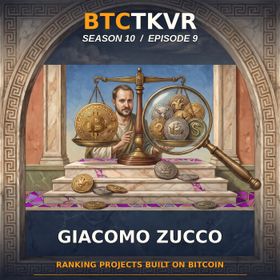
S10 E9: Are Bitcoin Tokens Scams? Giacomo Zucco on Bitcoin Maximalism
The audio keeps playing while you browse the site.
Read the transcript12,703 words, every line links to the minute it was said
Ask this episode
Are Bitcoin tokens scams? According to Giacomo Zucco (Bitcoin maximalist, BHB Network founder and one of the people who kickstarted RGB), it depends on how honestly they're sold: a protocol that simply uses Bitcoin is fine, but a token that borrows Bitcoin's reputation to sell something that's centralized is, in Giacomo's words, a cargo cult. Giacomo is the man who dissected Bitcoin maximalism on stage at Baltic Honeybadger in Riga back in 2018, so I've asked Giacomo to rate the scamminess of the projects that issue tokens on top of Bitcoin, from Counterparty and Omni to Liquid, Rootstock and Stacks.
This was Giacomo's third time on the Bitcoin Takeover Podcast. The first one was in 2019, when we argued about BIP 157 and 158 (the Neutrino light client filters), and the second was the Season 7 special with Mir, where we talked about everything except Bitcoin. Giacomo now admits that fight was probably a lost battle. And since Season 10 was my Counterparty season, full of Rare Pepe collectors bragging about paying miners fees, I figured somebody had to bring the counterargument.
Key takeaways:
- Giacomo's slogan (everything but Bitcoin is a scam) is a hyperbole and a heuristic, not a literal claim.
- Giacomo's ranking of token launches goes from no token at all, to two-way pegs, one-way burns and airdrops, down to pre-mines and ICOs.
- Counterparty's proof-of-burn rates far better than Omni's ICO, but the XCP token is still the weak spot.
- Liquid assets and Stacks are, in Giacomo's view, centralized systems with Bitcoin-sounding marketing.
Is Everything but Bitcoin Really a Scam?
Giacomo started with definitions, because the word maximalism was first used as a slur and later got reappropriated by Bitcoiners in a sarcastic way. Of course the claim can't be literal (otherwise gold, the internet and the chair Giacomo was sitting on would all be scams, which Pierre Rochard would agree with). What it means is that anything piggybacking on Bitcoin's success in order to legitimize something that wouldn't make sense on its own falls into this category:
"Scam means that most of the people believe that narrative, but the narrative can be arguably criticized and eventually debunked." (00:09:39)
Giacomo's favorite analogy is the dot-com era: shares of a company aren't a scam, but slapping a dot-com name on a company with no assets during the bubble was. Putting company shares on a blockchain works the same way, since they're still centralized, still regulated, and only dressed up to look like Bitcoin, like an airplane built from wood and bamboo. Giacomo even applied this to El Salvador's Volcano Bond on Liquid (Giacomo was even thinking of buying 100 bucks of it to support the initiative), asking why a name-based government bond needs a sidechain at all.
Then came the ranking. As Giacomo explains it, the best way to issue a token is to not issue one at all:
"the best way would be not to issue a token at all" (00:21:40)
If you really need one, a two-way peg comes next (Gregory Maxwell's coin witness idea or Paul Sztorc's drivechains), then a permanent one-way burn, then a temporary burn like Counterparty's, then an airdrop to Bitcoin holders, then a coin mined from scratch like Monero or Litecoin, and at the very bottom the pre-mine and the ICO, with Ethereum doing both. Counterparty itself is legit as a layer, but its token is the problem, even if burning bitcoin was way more honest than a sale. Omni (formerly Mastercoin) got the harshest verdict: an ICO, a rebrand and investors left holding a token the system no longer needs. Giacomo understood why John Carvalho's Synonym picked OmniBOLT for Tether on Lightning, since RGB wasn't ready, but called it disappointing.
Are Liquid and Stacks Scams?
Not exactly, but they're closer to the line than their fans think. According to Giacomo, the original sidechain idea was great, but the SPV design gave miners too much power, so Blockstream moved to a federation, at which point most of Bitcoin's design (blocks, proof of work, heaviest chain) stops being necessary. Liquid at least didn't issue its own coin. But a game token like Samson Mow's Infinite Fleet could have lived in a MySQL database, and Giacomo had told Samson that a game already has its money: satoshis.
Stacks got the Pokémon Go treatment. If a centralized game timestamps its database on Bitcoin with OpenTimestamps every day, is it secured by Bitcoin? Of course not, and that's why Giacomo considers the 'secured by the Bitcoin network' pitch an affinity scam: technically Stacks is slightly better than Ethereum, but the honesty of the claim is about the same. Giacomo went further and argued that Ethereum did more damage than OneCoin, because OneCoin never distracted smart developers away from Bitcoin.
We also talked about the two schools of maximalism, the one that wants Bitcoin left alone and the one of Paul Sztorc and Ruben Somsen that wants to bring altcoin features on top of it. Giacomo sides with both, as long as nobody rushes to change the base layer out of fear, and compared most token use cases to using the printing press for back massages. I couldn't resist reading out Junseth's old Reddit post explaining why Ethereum is a layer five, which Giacomo declared mandatory reading. Giacomo's own shitcoin phase started with Ripple (scammed directly by Satoshi, as Giacomo jokes, who had praised the old Ripple project before Ripple Labs launched the coin) and continued with NXT, a phase that luckily didn't cost Giacomo much money, time or reputation.
I expected Giacomo to just call everything a scam, Carlos Matos style, and instead I got a whole taxonomy. My own position, which I've defended during the episode, is that Counterparty is pretty legit because every transaction settles on Bitcoin, and I still think that. But Giacomo's closing argument also makes sense: the slogan is a heuristic for newbies, the same way you teach someone that Nigerian princes on email are scammers.
"it's a very good heuristic to say Nigerian princes are scammers in order to teach somebody to use email, especially a newbie." (01:24:46)
Giacomo had another interview right after ours and we ran over time, which says a lot about nuance. Needless to say, I'm grateful for it. If you're holding XCP after this episode, consider it a collectible, which is exactly what Giacomo predicted shitcoins would become back in Riga.
FAQ:
Is Counterparty a scam according to Giacomo Zucco? No. Giacomo calls Counterparty a legit layer on top of Bitcoin, but criticizes its XCP token, while admitting proof-of-burn was far more honest than an ICO.
What's the best way to issue a token on Bitcoin? In Giacomo's ranking, the best option is not issuing a token at all, followed by a two-way peg, a permanent one-way burn, a temporary burn and an airdrop.
Why does Giacomo consider Stacks an affinity scam? Because being secured by Bitcoin mostly means timestamping, while development and the token remain under a centralized team's control.
Listen to Giacomo Zucco on Spotify, Apple Podcasts, and More
The full transcript is on the S10 E9 transcript page. For Giacomo's earlier visits, hear S2 E8 on Neutrino and Bitcoin-only conferences and the Season 7 special with Mir. For the other side of the Counterparty debate, read S10 E11 with Rare Scrilla and hear S16 E14 with Adam Krellenstein. The projects Giacomo mentions: RGB, Counterparty, Liquid, Stacks and the original sidechains paper.
Time stamps of S10 E9 of the Bitcoin Takeover Podcast, featuring Giacomo Zucco:
- 00:00:00Intro
- 00:00:47Welcome: Giacomo Zucco
- 00:01:24Projects built on Bitcoin: are they still scams?
- 00:03:31Where to start
- 00:04:12Is Counterparty a scam?
- 00:09:39What "scam" really means
- 00:15:40Using the shape of the airplane
- 00:18:19Counterparty and its token
- 00:21:07Concluding on Counterparty
- 00:25:52Omni, Synonym and OmniBOLT
- 00:30:20Tether and why it uses blockchains
- 00:31:58Sponsors: Vaultoro, Wasabi Wallet, Bitcoin Reserve
- 00:35:14Liquid and issuing tokens
- 00:35:44The idea of sidechains
- 00:44:45Is Liquid a scam?
- 00:50:16What happens if Vitalik changes Ethereum
- 00:56:14What is Bitcoin maximalism?
- 00:56:42Paul Sztorc's school of thought
- 00:57:55Wrapping Bitcoin on Ethereum
- 01:03:12Sound money and society
- 01:06:52Ethereum as a layer five
- 01:12:12If more Bitcoiners had been like Junseth
- 01:14:40Sponsors: Vaultoro, Wasabi Wallet, Bitcoin Reserve
- 01:17:51The shitcoin that got Giacomo started
- 01:21:08Shitcoins as collectibles
- 01:25:23Wrapping up
- 01:27:06Sponsors: Vaultoro, Wasabi Wallet, Bitcoin Reserve
Verify this episode
This is the SHA-256 fingerprint of the MP3 as published here, timestamped in the Bitcoin blockchain with OpenTimestamps. If one byte of the file changes, the fingerprint changes.
- SHA-256
618f13c2becdae3f7dd4d7791df26cc229056907f95319cc9897689ca85b9dee- Proof
- 2022-02-24_s10_e9__giacomo_zucco_on_bitcoin_scams_and_the_nuances_of_maximalism.mp3.ots · all episode hashes (proof)
- Status
- Anchored in Bitcoin block 974,312
- Timestamped
- After release. The episode came out on 24 Feb 2022, but this proof was made on 3 Nov 2026 and anchored in block 974,312, so it proves this exact file existed by 3 Nov 2026, not on the release date.
How to check it yourself
- Download the MP3 and the proof into the same folder.
- Run
sha256sum 2022-02-24_s10_e9__giacomo_zucco_on_bitcoin_scams_and_the_nuances_of_maximalism.mp3(on a Mac:shasum -a 256 2022-02-24_s10_e9__giacomo_zucco_on_bitcoin_scams_and_the_nuances_of_maximalism.mp3). The result must match the SHA-256 above. - Install the OpenTimestamps client (
pip install opentimestamps-client) and runots verify 2022-02-24_s10_e9__giacomo_zucco_on_bitcoin_scams_and_the_nuances_of_maximalism.mp3.ots. It hashes the MP3 again and checks the proof against your own Bitcoin node, then prints the block and the date the file existed by. Without a node,ots info 2022-02-24_s10_e9__giacomo_zucco_on_bitcoin_scams_and_the_nuances_of_maximalism.mp3.otsshows the block height to look up in any block explorer.
Related
S12 E7: What Is Client-Side Validation? Dr. Maxim Orlovsky on RGB (Full Article)
Recorded in Riga, Dr. Maxim Orlovsky explains what RGB really stands for, why Peter Todd's client-side validation means most…
S12 E7: Dr. Maxim Orlovsky on RGB Layer 3
Maxim Orlovsky is the main developer of RGB: a layer 3 protocol that’s built on top of Bitcoin’s Lightning Network. Contrary to…
S17 E11: What Is the Atomic Economy? John Carvalho on Bitcoin Depression
John Carvalho was the second guest in the history of this podcast, way back in season one, episode two, when he was…

Comments
Questions or corrections? Email me, or say it on Nostr or X. I read all three.
Email meNostrX