




Adrian, Patrick and Bastian on Lipa Lightning Payments (S11 E3 Full Article)
The audio keeps playing while you browse the site.
Read the transcript3,487 words, every line links to the minute it was said
Ask this episode
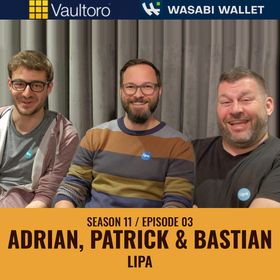
We were still in Istanbul, at the Lightning Hackathon, when I sat down with three people I had never heard of. That was the interesting part. Adrian, Patrick and Bastian are the co-founders of Lipa, a Swiss startup building Lightning payments for bars and restaurants. It was their first podcast, and they were still in stealth mode.
Season 11 is about projects that fly under the radar, and Lipa was flying very low. We talked about why they didn't just tell businesses to use BTCPay Server, how the app works for owners and waiters, what's custodial and what isn't, the business model and why Switzerland. The original show notes have the short version.
Why Not Just Use BTCPay Server?
That was my first question. There's already a free, self-hosted tool that lets merchants accept bitcoin, so why build another one?
Patrick started from the big picture. "We saw that Bitcoin adoption needs businesses accepting Bitcoin as payments. And, well, Lightning is the payment layer for Bitcoin." They could have sent every business to BTCPay Server, "but our experience was that businesses don't like to have an additional device. They don't want to have an additional device running and have to maintain it."
His conclusion: "Nowadays it's still too complicated for a regular business like a bar or restaurant just to run such a device in order to accept just, yeah, Bitcoin payments."
I think that's an honest read of the market. Bitcoiners love running nodes. A restaurant owner wants the card terminal to work and the books to balance.
Who Does What
The three split the work cleanly. Patrick does "most of the software engineering together with our software engineering team, also some software architecture." Adrian is "more on the business side," trying "to be the bridge between software engineering and visual stuff." Bastian is the "technical product owner," deciding "what features to be next."
Why You Hadn't Heard of Them
I asked where they'd been hiding. "As for now, we are pretty much in stealth mode," Bastian said. They had started in February 2021. Building the backend and frontend took most of that time.
They were already live, just small. "We are actually in a friends and family phase. We are already on mainnet. We have some customers, some restaurants and bars who are already using Lipa as a payment solution to receive Lightning payments." The app was on TestFlight, so they "can gather feedback and make the application much more easy and much more usable."
Adrian added the obvious missing piece. "Marketing." They were "more the technical guys," and he called himself "the least technical one, but I'm still a software engineer from my background."
Custodial Today, Non-Custodial Tomorrow
This is the part I want to be precise about. I asked if Lipa was free and open source. Patrick was candid. "The current implementation we have is just some sort of MVP, and also it's not fully non-custodial. It is basically custodial. That's also why we are in stealth mode."
The plan was to fix that before going public. "We are currently working on creating the non-custodial solution. And especially the Lightning parts, they will be open source." They had also published a test project with LDK, the Lightning Development Kit: "this sample implementation, well, it's not production ready, definitely not, but it's open source. You can find it on GitHub."
Bastian said they planned "to open source most of the application," apart from "some very business-related stuff, which will be kind of a company secret." The license wasn't picked yet: "we haven't decided on the license yet. This is why we also cannot open source it at the moment."
I respect that they said it straight. Plenty of companies call themselves non-custodial when they aren't. These three told me exactly where they stood and what they were building toward.
How It Works at the Table
Bastian walked me through the flow. A business registers with some details, "like a VAT number or something, so we actually can find you in a register," and an email address. Onboarding is a QR code scan.
Then "you will basically see a terminal, which is a number block and an input field. So that's basically it." The waiter types the amount "in Swiss francs, in euros, in dollars," and the app does "the calculation to satoshis, and then presents you a Lightning invoice." The customer can use any wallet "because we're using the Lightning invoice standard. And then the customer pays, and that's it, basically."
Adrian highlighted a detail that matters for any real business. "The business owner will be able to add as many employees or devices also as they want." And crucially, "the employees will not be able to access the wallet," because "your employees cannot just send away your funds, right?"
Owners, Waiters and No Frozen Funds
I asked whether an owner could take money from waiters or block them. Bastian explained the "two-tier role system." The waiter installs Lipa, the owner "creates a new employee in his application and shows a QR code to this employee," and the waiter "is instantly able to create invoices."
"The waiter will always work on behalf or act on behalf of the business, there is no freezing funds or nothing." If someone leaves, the owner "just deletes it, or he can temporarily inactivate this employee."
Adrian made the boundary clear. It "will not have any effect on the employee's wallet, private wallet." For the waiter, "it's just a terminal, a payment terminal for that business."
How Lipa Plans to Make Money
Everyone expects Bitcoin startups to open source everything, so I asked how they'd pay the bills. "Of course, we cannot work for free. It would be nice," Adrian said. "We have a commission that we take, so a transaction fee for each transaction."
The second stream would come from exchanges. A new wallet starts with "zero funds," so they wanted to make it easy to buy bitcoin, and "there we will also get some fee."
Simple for Staff, Simple for the Accountant
For the public launch, Adrian promised "Bitcoin to Bitcoin in the beginning. So it will be only Bitcoin payments, no fiat payments." The priority was ease of use. "For an employee, it's no tool to learn or anything."
He also brought up the question every business owner asks. "Now I'm using Bitcoin, but how do I use it in an accounting way?" Lipa planned "proper exports" that work with "the accounting tools the businesses use." That's the kind of boring feature that actually gets merchants on board.
Why Switzerland
They're based in Switzerland, and Adrian gave two reasons. The first is "stability. So it's not just tomorrow it will be different from today how the regulation is." The second is the neighbors: "Crypto Valley is in Zug, and a lot of Bitcoin companies that we also partner or try to partner with are there."
He was realistic about licensing, though. "To operate as a payment provider, it has many implications in each country, so it doesn't really matter where you're located."
The Dua Lipa Question
I had joked earlier with Bastian about getting Dua Lipa to promote them. It turns out they thought of it first. When they googled the name, "the only interesting content that we could find really is Dua Lipa." Adrian's pitch: "If Dua Lipa watches or listens to your podcast, here we are, please contact us." To be clear, that's a joke, not a plan.
What Makes This Episode Worth Listening To
It's a short, early look at a team trying to make Lightning boring enough for a busy restaurant. They're upfront about the custodial MVP and the road to non-custodial, and they think about the things merchants actually ask, like staff roles and accounting. To follow them, Bastian pointed to Twitter: "It's lipa_BTC."
You can read the full transcript, the original show notes, or visit the guest pages for Adrian, Patrick and Bastian.
Listen to Adrian, Patrick and Bastian on Spotify, Apple Podcasts, and More
Time stamps:
- 00:01:52– Why not BTCPay Server
- 00:03:01– Who does what
- 00:04:41– Stealth mode
- 00:05:47– Marketing
- 00:06:40– A custodial MVP
- 00:07:46– Open source plans
- 00:09:03– How it works at the table
- 00:10:32– Employees can't move funds
- 00:14:37– Business model
- 00:15:58– Bitcoin only at launch
- 00:16:55– Accounting
- 00:17:47– Owners and waiters
- 00:18:50– The employee's own wallet
- 00:19:40– The Dua Lipa question
- 00:20:35– Why Switzerland
- 00:21:14– Licensing everywhere
- 00:22:01– Where to follow Lipa
Verify this episode
This is the SHA-256 fingerprint of the MP3 as published here, timestamped in the Bitcoin blockchain with OpenTimestamps. If one byte of the file changes, the fingerprint changes.
- SHA-256
cda1534e6d5260a8b9620e996b1dc267d024a2a053166648b392e5f8781519ed- Proof
- 2022-05-27_s3_e11_lipa_lightning_network_payment_adrian_patrick_bastian.mp3.ots · all episode hashes (proof)
- Status
- Anchored in Bitcoin block 974,312
- Timestamped
- After release. The episode came out on 27 May 2022, but this proof was made on 3 Nov 2026 and anchored in block 974,312, so it proves this exact file existed by 3 Nov 2026, not on the release date.
How to check it yourself
- Download the MP3 and the proof into the same folder.
- Run
sha256sum 2022-05-27_s3_e11_lipa_lightning_network_payment_adrian_patrick_bastian.mp3(on a Mac:shasum -a 256 2022-05-27_s3_e11_lipa_lightning_network_payment_adrian_patrick_bastian.mp3). The result must match the SHA-256 above. - Install the OpenTimestamps client (
pip install opentimestamps-client) and runots verify 2022-05-27_s3_e11_lipa_lightning_network_payment_adrian_patrick_bastian.mp3.ots. It hashes the MP3 again and checks the proof against your own Bitcoin node, then prints the block and the date the file existed by. Without a node,ots info 2022-05-27_s3_e11_lipa_lightning_network_payment_adrian_patrick_bastian.mp3.otsshows the block height to look up in any block explorer.
Related
S11 E3: Adrian, Patrick & Bastian on Lipa
Lipa is a Swiss-made service which aims to make Bitcoin payments simple. At first glance, it’s a wallet with Point of Sale…

S1 E2 Remastered: John Carvalho on Bitcoin Politics, the Foundation’s Failures & That Roger Ver Interview
(Recorded January 2019, remastered 2025. Sponsored by Helen’s Pizza in Jersey City, 183 Newark Avenue, where you can pay with…

S17 E29: Grafton Clark on Vibe Coding, Privacy & Bitcoin Culture
Some podcast episodes are about a product, a protocol, or a company. This one is about a feeling: the feeling that the…

Comments
Comments run on my own server. No trackers, no tracking cookies.