




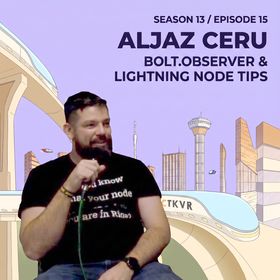
S13 E15: Aljaž Čeru on Bolt.Observer & Lightning Node Tips
The audio keeps playing while you browse the site.
Read the transcript6,348 words, every line links to the minute it was said
Ask this episode
Every new Lightning enthusiast has the same dream. Buy a Raspberry Pi, install RaspiBlitz or Umbrel, open a few channels and watch the routing fees roll in. I had that dream too. I bought the hardware, a metal case and even a UPS, joined two channel-swapping communities, and ended up routing about ten payments a week.
So when I watched Aljaž Čeru present the "Lightning Nodes Pyramid of Needs" at the Baltic Honeybadger conference in Riga, complete with a joke about Bitcoiners being used to pyramid schemes, I knew I had found the right person to tell me what I did wrong. Aljaž is the CEO and co-founder of Bolt.Observer, a startup that builds monitoring and management tools for Lightning node operators, and a co-founder of the Bitcoin Ljubljana meetup in Slovenia. Before Bolt.Observer, according to the Adopting Bitcoin 2022 speaker bio, Aljaž was Head of Platform at Bitstamp.
We sat down at the conference for about 40 minutes. The result is a practical lesson in node economics, with two opinions that Aljaž openly flagged as controversial.
The Dream and the Reality of Routing
Aljaž did not sugarcoat it. Earning yield self-custodially is "the dream of every new Lightning enthusiast," but most of those nodes are not profitable. Managing a routing node properly, in Aljaž's words, is "a part-time job." That complexity is the reason Bolt.Observer exists: the long-term plan is to automate node management so operators do not have to babysit their channels.
The first question, according to Aljaž, is what you want from your node. A personal wallet node just needs to be good enough to "pay for your beers," and occasional downtime is fine. A merchant selling Bitcoin swag needs uptime and inbound liquidity, because without it "you're not able to sell any shirts, and that is bad, both for you and the Bitcoiners that don't have t-shirts." A routing node needs something harder: capital deployed where it is actually used. If your channels route nothing, "you just basically trade at a risk for no reward," moving Bitcoin from cold storage into a hot wallet for nothing. I added the obvious footnote: you also pay fees, so you end up with less Bitcoin.
What I Did Wrong With My Node
I described my setup: a RaspiBlitz on a Raspberry Pi 4 with an SSD, a UPS, channels with people I liked, and memberships in Rings of Fire and Lightning Network+. Aljaž said my channel sizes were probably one problem, but position in the graph matters more. There are two ways to earn, Aljaž explained. Either you are hyper-connected with balanced, two-way traffic, which is rare and needs a lot of Bitcoin, or you sit where there is liquidity demand and charge more, while drains like exchanges keep emptying your channels.
Then came the question that exposed me. Was I running a Tor-only node? Of course I was, because I did not want to dox my location. "Yeah, that could be one of your problems," Aljaž said. Tor is great for privacy, but in tests Bolt.Observer ran, a few Tor hops could turn a 200-millisecond hop into 20 seconds. Nobody wants "a stare-down with a barista" while a coffee payment hangs. I could only picture strangers stuck at a café counter because of some guy in Romania routing over Tor.
Will the Backbone Run on Raspberry Pis?
I asked directly whether the future of Lightning payments runs on home-hosted Raspberry Pis. "No," Aljaž answered, and then explained why this was the first of two controversial opinions. Having that option is great, but the backbone of the network will be cloud-hosted or in data centers with redundant power and internet. Aljaž pointed to mempool.space data on how much Lightning capacity already sits with hosting providers.
The bigger message was about maturity. Implementations are only slowly adding high-availability features, and companies in the ecosystem say that is exactly what they miss. "We need to start providing enterprise-level tools, even though we're all pirates and hackers and cypherpunks," Aljaž said, if the goal is to onboard a billion people.
After the sponsor break I asked the obvious follow-up: if Tor adds latency, is a VPN like Mullvad better? Many operators, Aljaž said, already use a cloud instance for a public IP with a VPN tunnel home, so they do not reveal their residential address. Large Tor-only routing nodes do exist and succeed, but Tor is "not always slow, but sometimes it's that slow," and unpredictability is the real enemy. A replacement for existing payment methods has to be ten times better before people switch.
Climbing the Pyramid of Needs
I had taken a picture of the slide, and Aljaž walked me through it from the bottom up.
Reachability comes first. As a Lightning node, "you have to be online 24/7," or at least whenever it accepts payments, which already sets home connections apart from data centers with redundant links. Reliability comes next: you need channels open and peers that are actually online, and as a routing node you suffer if your peers keep going up and down.
Predictability is the level Aljaž kept returning to. You want to be reasonably sure a payment will go through "in less than three seconds," the way a card tap does. In good conditions Lightning already beats that, as the Bolt Card has shown, while QR codes in sunlight on bad Wi-Fi remain "just horrible."
Then comes financial viability, covering at least what you paid in opening and closing fees, including force closures that land at unfortunate moments. At the top sits profitability, which Aljaž called "the Holy Grail" for a reason. Running a node on AWS with proper backups could cost around $150 a month before any channel fees.
Bosworth, Big Nodes and Local Routing
Bolt.Observer's tooling, Aljaž said, targets businesses and serious routing nodes more than casual users. Aljaž was honest about the threshold: "you probably won't run a profitable node with 100k sats." You would need a couple of Bitcoin, or a merchant friend who needs inbound liquidity.
I brought up Alex Bosworth, whom I remembered tweeting about earning around two Bitcoin from routing, and who also has the advantage of being one of the oldest nodes and someone who builds Lightning tooling. Aljaž agreed that the early network created "a self-fulfilling prophecy": everyone connected to the same big nodes, scoring systems reward that, and many channels end up routing little.
The prediction was that real economic activity will reshape the graph. People will connect to suppliers, local wallet providers or community banks, much like the internet has local and regional exchanges. "It also doesn't make sense to route a payment through the entire world if we're next door to each other."
Inside Bolt.Observer
Bolt.Observer's first product was reachability monitoring: add your node, and it checks your Tor, IPv4 and IPv6 connectivity and alerts you if something breaks, such as a misconfigured firewall or a dead Tor daemon, "which it's known to happen." The explorer grew out of the company's own needs. One filter I liked lets you mark your node and show only nodes more than three hops away, which helps find peers outside what Aljaž calls your neighborhood. It also adds latency scans and channel-size filters.
Everything was free at the time, with paid features planned around read-only node access. The example was concrete: an alert when a channel balance falls below 25%, and a webhook to trigger automatic rebalancing below 5%. The customer, in Aljaž's view, is the small startup that cannot hire scarce node operators and just wants to "build your own cool shit on Lightning."
Bitcoin Ljubljana and Bitcoin Without the Philosophy
Ljubljana, Aljaž told me, may be one of the best-covered cities in Europe for Bitcoin payments, with several big shopping centers accepting it. The meetup started as a group of Lightning operators drinking beer and now gathers "between 40 and 50 people every month." One story stuck with me: a friend who presented at the meetup had been saved in Cuba by selling Bitcoin when fiat could not get into the country.
When I asked whether the region's communist past helps people understand Bitcoin, Aljaž would not generalize. "Bitcoin can be many things to many people." That fit the presentation in Riga, which argued that Lightning should be usable without adopting the philosophy. Most people "just want to pay for coffee," and Lightning could end up like the internet: "You're not going on the internet, you're going to Twitter or whatever you want."
The second controversial opinion closed the interview. Not everybody needs to run a node, and Aljaž would not try to convince a pair of parents who "barely can keep up with their passwords." Custodial options, community banking and Fedimints each have their place. I disagreed and said we should only make running nodes easier. We agreed to settle it over a beer, and Aljaž estimated that "will require a couple of beers."
If you want to go deeper into running your own Lightning node, read my interviews with Lisa Neigut on running a Core Lightning node from home and with Rootzoll and Matthew Croughan on RaspiBlitz, or my episode with Slava Zhygulin and Nick Schteringard on Stroom, about the opposite end of the network: big routing hubs. More conference conversations live on the Baltic Honeybadger topic page, and the full transcript of this episode is on the site.
Listen to Aljaž Čeru on Spotify, Apple Podcasts, YouTube, and More
Time stamps:
- 00:00:00– Intro
- 00:00:30– Welcome: Aljaž Čeru at Baltic Honeybadger
- 00:01:15– The Lightning Nodes Pyramid of Needs
- 00:01:47– Why most home routing nodes disappoint
- 00:03:08– What matters most depends on your goal
- 00:05:31– What I did wrong with my RaspiBlitz
- 00:07:52– Tor-only nodes and latency
- 00:09:09– Will the backbone run on home Raspberry Pis?
- 00:11:19– Sponsors: Wasabi Wallet, Cryptosteel, Bumbee, ShopinBit
- 00:15:38– Tor vs. VPN for routing nodes
- 00:17:36– The pyramid: reachability and reliability
- 00:20:54– Predictability and the card-tap benchmark
- 00:21:37– QR codes, Bolt Card and financial viability
- 00:22:20– Force closures and the Holy Grail of profitability
- 00:24:01– What Bolt.Observer builds
- 00:25:19– Alex Bosworth and the big-node advantage
- 00:26:48– Local routing, like internet exchanges
- 00:27:47– Bolt.Observer's explorer vs. mempool.space
- 00:30:31– Free tools, paid features and private data
- 00:32:04– Who needs this kind of tooling?
- 00:33:24– The Bitcoin Ljubljana scene
- 00:35:43– Does the communist past help?
- 00:36:38– Using Bitcoin without the philosophy
- 00:38:04– The future of Lightning
- 00:39:49– Sponsors: Wasabi Wallet, Cryptosteel, Bumbee, ShopinBit
Verify this episode
This is the SHA-256 fingerprint of the MP3 as published here, timestamped in the Bitcoin blockchain with OpenTimestamps. If one byte of the file changes, the fingerprint changes.
- SHA-256
e14024a1d3fae959ff45773a0ae22d2eb9538532dfdaa65f6b814412ff827688- Proof
- 2023-05-04_s13_e15_aljaz_on_bolt_explorer_and_lightning_node_tips.mp3.ots · all episode hashes (proof)
- Status
- Anchored in Bitcoin block 974,312
- Timestamped
- After release. The episode came out on 4 May 2023, but this proof was made on 3 Nov 2026 and anchored in block 974,312, so it proves this exact file existed by 3 Nov 2026, not on the release date.
How to check it yourself
- Download the MP3 and the proof into the same folder.
- Run
sha256sum 2023-05-04_s13_e15_aljaz_on_bolt_explorer_and_lightning_node_tips.mp3(on a Mac:shasum -a 256 2023-05-04_s13_e15_aljaz_on_bolt_explorer_and_lightning_node_tips.mp3). The result must match the SHA-256 above. - Install the OpenTimestamps client (
pip install opentimestamps-client) and runots verify 2023-05-04_s13_e15_aljaz_on_bolt_explorer_and_lightning_node_tips.mp3.ots. It hashes the MP3 again and checks the proof against your own Bitcoin node, then prints the block and the date the file existed by. Without a node,ots info 2023-05-04_s13_e15_aljaz_on_bolt_explorer_and_lightning_node_tips.mp3.otsshows the block height to look up in any block explorer.
Related

S13 E8: Emzy on Mempool.space, Running Electrum Servers & Bitcoin Jobs
Emzy is a well-known and respected server infrastructure provider, best known for his involvement in the Electrum and the…

S12 E13: Max Keidun on Baltic Honeybadger 2022 & Debifi
Max Keidun is a man of many talents and with a Gargantuan involvement in the Bitcoin space. The conference that he has…
Max Keidun on Baltic Honeybadger 2022 and Debifi (S12 E13 Full Article)
Recorded in Riga right after Baltic Honeybadger 2022, Max Keidun explains why the conference stays Bitcoin-only and small, why…

Comments
Comments run on my own server. No trackers, no tracking cookies.