




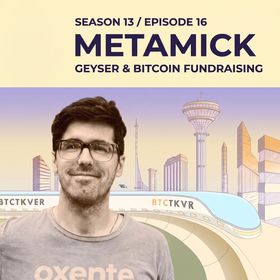
S13 E16: MetaMick on Geyser and Bitcoin Fundraising
The audio keeps playing while you browse the site.
Read the transcript6,174 words, every line links to the minute it was said
Ask this episode
I came into this interview with a prejudice. Crowdfunding means somebody collects money and then vanishes, and I said as much to Mick Morucci within a minute of sitting down: "I guess there were rug pulls in Bitcoin before there were anywhere else." The question I wanted answered was how a platform where strangers send each other sats could possibly be built without becoming a rug-pull dispenser. Mick, the MetaMick of Twitter, is co-founder and CEO of Geyser, and the answer he gave me involved far less promised magic than I expected, plus one story about a fake campaign that he told against his own platform.
We recorded at the Libertarian conference at a film festival in Warsaw, and the conversation ran about 34 minutes. Much of it turned out to be about what happens around the money rather than the money itself: who gets to be believed, who pays whom, and how a creator keeps people interested after the first donation.
Fireworks With No Follow-Through
Mick dates the idea to the Bitcoin community around 2020 and 2021. "there was so much effervescence, so many ideas sparkling, so many people with these ideas, and then oftentimes nothing was being done about it." The people with ideas had no real place to ask for funding. "They were just sort of adding lightning QR codes on their Twitter feed and hoping that people will fund."
Geyser is a crowdfunding platform for Bitcoin projects that runs on the Lightning Network. A creator posts a project, funders send sats, and the page keeps a running record of who gave what. Mick pointed to a very mixed bag of campaigns when I asked what kinds of things get funded: Bitcoin for Fairness, the project of Anita Posch at bffbtc.org, Bitcoin trading cards, a Bitcoin racing car, educational platforms like Mi Primer Bitcoin, the clothing brand CryptoCloaks, Bitcoin Block Munich, and a show called Between Two ASICs. On that last one, he described someone taking an existing event and turning it into a Bitcoin show: "transform it into a Bitcoin show, calling it Between Two ASICs."
I asked how he picks winners. He doesn't. "And the only way to make it happen is to not govern centrally and decide what's a good idea." Instead, he said, "put out a tweet about your idea and see what the community says." Lightning also makes payments small and fast enough that, in his words, "even just in a matter of a day or two, your project can receive hundreds of contributions, millions of sats, and that idea can happen."
Twitter as the Trust Layer
My main worry was impersonation, and Mick's answer began with Twitter. "So Twitter represents currently that social trust layer," he said, referring to the "power of platforms," in his phrase. Users log in with Twitter, which lets a project page show who is actually behind it. Geyser also partners with Hive.one for social ranking.
I pushed on whether follower counts mean anything. Mick agreed they don't, by themselves: "It's easy on Twitter to convince 10,000 people from a like farm or whatever to follow you and you're going to look like you're influential and big." Hence the Hive.one angle, because for him the relevant question is "are you actually in the network?" A newcomer is still welcome: "Again, you can still create a project with zero friends, right?" What the ranking surfaces is the track record.
Along these lines I offered a thesis of my own, which Mick took on board: "Also, even though Bitcoin is trustless, a Bitcoin world requires not necessarily a trust system, but a reputation system, where you can see the track record of every actor." I added that "you need a reputation before you can ask others to pay you in Bitcoin." His advice to creators was close to a dress code: "Show your face. You may be an anon, and that's totally fine as well. But it does usually help to see someone who you can trust a little more."
The Praia Bitcoin Brazil Fake
Then came the incident that shows what these safeguards are up against. Someone created a campaign impersonating Praia Bitcoin Brazil, the real organization. Two people donated a total of 10,000 sats before it was caught. Mick put the blame on his own team's shoulders: "And that was more a problem on our end for not actually noticing it," because "what was missing was the social net."
Geyser's rule on deletion is blunt: "You can't delete a project on Geyser unless it's received no funding at all." Once someone has paid, the project page stays, which protects funders from a creator who tries to erase evidence. The flip side is that a fake that has collected anything stays on the site as well, which is where social verification has to do the work.
The planned fix is Nostr. Geyser is adding Nostr login alongside Twitter, and Mick explained the direction: "So you're going to be able to log in with Nostr on Geyser and create a project through your Nostr account." Geyser would then be a window onto what already lives on Nostr, "We're just more of like of an interface." Native Nostr update broadcasting for campaign milestones is also on the list, because "keeping the community up to date socially is absolutely critical. And we have, we are aware of the problem." Mick gave me his NIP-05, metamick@nostrplebs.com, and mentioned that Nostr badges are minted from user keypairs and can be gifted. They are not meant as speculative NFTs. When I asked, he said "No, not quite. Because mainly they're not tradable."
HODL Invoices and a Non-Custodial Pipe
Technically, the thing that lets Geyser avoid holding anyone's funds is the HODL invoice. Mick described it step by step: "So every payment goes through the Geyser node in a non-custodial way." The sequencing is the point: "we only receive the funds from the sender after we have sent the money to the receivers." Geyser never sits on a pile of user money.
On the fee, Mick laid out two tiers. A project that uses a Lightning address pays 2%, and "the creator gets 98%." A project that connects directly to its own node pays no fee. He thinks this design has a side effect: "because we believe that we actually incentivize people to run their own nodes." I wondered aloud whether charging fees at all amounts to "monetizing your project off of everyone else's monetization." His answer was about friction. "there needs to be some costliness so that funding is real."
He also told me that "We noticed that 30% of funders actually come from within the platform," meaning people who found one project and then browsed to another. Funders who start on Geyser tend to stay on Geyser, and Mick is happy to take that as a reason to keep it a place where people browse.
Not Yet at Break-Even
I asked the awkward question, whether the 2% pays the bills. "It's not. Right now we're not in break-even, but we're relying on the long-term projection of Bitcoin." What he did offer was a growth claim: "50% growth month over month for the last four or five months."
His bet on why it will keep growing is that the next gains for Bitcoin are not in the protocol. "we think it's these next layers, namely the social layer of Bitcoin, that will help Bitcoin go to the next level, that will help hyper-Bitcoinize the world." Most people, he reminded me, will not write code. "98% of the world doesn't know how to code, and probably don't know what money is." The aim is to let them "play a part in world-changing ideas."
He also said he is "bullish on Bitcoiners that are supporting these creators, that are giving back value for the value that creators are providing to the network." Some of the funding, he said, is grassroots in the most literal sense: "And I think there are people in Africa just simply orange-pilling, asking for donations and just giving sats away." The money pays for in-person orange-pilling, where an advocate meets someone and explains Bitcoin face to face.
I later recorded S16 E17: Ben Arc on LNBits V1 & The State of Lightning Network and S14 E14: Michael Bumann on Building Alby, Nostr & Lightning Network Development.
What Lightning Still Cannot Do
I asked about the features he wished Lightning had. Recurring support was first. "I wish that it was easier to subscribe," he said. A second problem is that crowdfunding often depends on all-or-nothing pledges, where money is only released if the goal is hit. Mick described the underlying need as funds "locked up in a contract." Then he drew the line between layers: "On-chain it's totally doable with HTLCs. But on Lightning it's kind of doable but not great."
So a project on Geyser today runs on plain donations rather than escrowed pledges that vanish if the goal is missed. Because of that, as I told him, "you have to remind people constantly that it's out there and push it." Mick agreed: "It's not enough to just sit back and let people fund you or expect people to fund you."
I mentioned my own plan on the show: "I'm gonna try to create the first project to raise 1 Bitcoin and write history there for Geyser." The project is meant to debunk Bitcoin myths. When I asked how funders see the campaigns they are choosing among, Mick said that "So you can pick and decide where the funds go to," and added that even a heavy user is looking at a sea of options: "I have to pick among 360 projects."
Merch Pins, Tatum Turn Up and a Ring
The best sales story of the day came from the trading-card side. Mick said one seller "I think he's sold more than 100 different pins in just three, four hours." He gave Tatum Turn Up as the example for his main advice to would-be creators: "Sometimes you have this skill and you love Bitcoin. Well, put those two things together and you'll find some unexpected things that will happen." Or, as he put it elsewhere, "Just bring your passions, your skills together."
His standing recommendation for bad market days is also simple. "And if you're ever feeling like a bit of FUD, just go on geyser.fund and just see how much is happening." As he said, "Every day there is something new."
Mick's wife had joined us for the last stretch, and she weighed in on the stranger corners of the platform, saying she "was quite surprised that there was a race that wanted a Geyser... That wanted Bitcoin to support a race car." On the early days of the project, she said, "Yeah, those were very early ones."
I stumbled over how to describe her and called her his girlfriend. Mick corrected me on the spot: "My wife. Wife." Then he grinned and told me that he had "put a ring on it."
If you want to find Mick, he is @metamick14 on Twitter, and the platform is @geyserfund.
Listen to MetaMick on Spotify, Apple Podcasts, YouTube, and More
Time stamps:
- 00:00:51– Welcome and meet MetaMick
- 00:01:43– Skepticism after Dark Wallet and old rug pulls
- 00:02:29– How Geyser began: ideas on Twitter with no way to fund them
- 00:03:40– Twitter as a social trust layer
- 00:04:52– Hive.one social ranking and Nostr login
- 00:06:44– Hundreds of contributions in a day or two
- 00:07:19– Geyser versus GoFundMe and Kickstarter
- 00:08:07– Who trusts you: the social graph
- 00:08:38– The Praia Bitcoin Brazil impersonation
- 00:10:12– Reputation systems in a trustless world
- 00:10:49– Connecting a node or a Lightning address
- 00:11:58– The 2% fee and HODL invoices
- 00:12:40– Geyser's business model
- 00:13:05– Why 2% and how it compares
- 00:14:29– Is 2% enough to sustain Geyser?
- 00:16:02– Hyperbitcoinization and the social layer
- 00:16:47– Films, books and educators on Geyser
- 00:18:32– The most successful projects
- 00:20:24– My one Bitcoin challenge
- 00:21:15– Per-language funding and Nostr badges
- 00:22:33– The Greenpeace green skull pins
- 00:24:05– Race cars and football coaches
- 00:24:34– Between Two ASICs and Bitcoin Block Munich
- 00:26:47– What Lightning still can't do
- 00:28:08– Advice for new creators
- 00:30:32– How to reach Mick
- 00:31:24– Why campaigns die in silence
- 00:33:35– Wrap-up and Nostr handle
Verify this episode
This is the SHA-256 fingerprint of the MP3 as published here, timestamped in the Bitcoin blockchain with OpenTimestamps. If one byte of the file changes, the fingerprint changes.
- SHA-256
584d64e0f655cc6e3dc8a1c1fdd9b57490473860500908e03889ddddaaddf3b6- Proof
- 2023-05-11_s13_e16_michele_morucci_metamick_on_geyser_and_bitcoin_fundraising.mp3.ots · all episode hashes (proof)
- Status
- Anchored in Bitcoin block 974,312
- Timestamped
- After release. The episode came out on 11 May 2023, but this proof was made on 3 Nov 2026 and anchored in block 974,312, so it proves this exact file existed by 3 Nov 2026, not on the release date.
How to check it yourself
- Download the MP3 and the proof into the same folder.
- Run
sha256sum 2023-05-11_s13_e16_michele_morucci_metamick_on_geyser_and_bitcoin_fundraising.mp3(on a Mac:shasum -a 256 2023-05-11_s13_e16_michele_morucci_metamick_on_geyser_and_bitcoin_fundraising.mp3). The result must match the SHA-256 above. - Install the OpenTimestamps client (
pip install opentimestamps-client) and runots verify 2023-05-11_s13_e16_michele_morucci_metamick_on_geyser_and_bitcoin_fundraising.mp3.ots. It hashes the MP3 again and checks the proof against your own Bitcoin node, then prints the block and the date the file existed by. Without a node,ots info 2023-05-11_s13_e16_michele_morucci_metamick_on_geyser_and_bitcoin_fundraising.mp3.otsshows the block height to look up in any block explorer.
Related
S14 E5: Ben Arc on LNBits and Nostr
Ben Arc is the creator of LNBits: a modular Lightning wallet which empowers users to pick their desired features (presented as…
S14 E11: Pavlenex, Kukks & Anna on BTCPay App at Baltic Honeybadger 2023
Recorded on the last day of Baltic Honeybadger 2023: Pavlenex, Kukks, Dennis Reimann and Anna on the BTCPay App, LDK, Lightning…
S16 E18: Rockstar Dev & Max Hillebrand on Privacy
Rockstar Dev and Max Hillebrand on CoinJoin after zkSNACKs, Nostr, vibe coding, Drivechains and how to compartmentalize your…

Comments
Comments run on my own server. No trackers, no tracking cookies.