




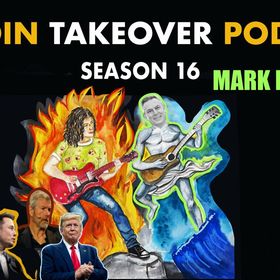
S16 E26: Mark Edge on Freeing Ian Freeman & Free Talk Radio
The audio keeps playing while you browse the site.
Read the transcript16,520 words, every line links to the minute it was said
Ask this episode
Mark Edge has been on the air for over 20 years with Ian Freeman, and he says the show sold Bitcoin to America's libertarians before Bitcoin had a price worth mentioning. He also says he will not store private keys at home, will not sleep in a building where keys are kept, and has stopped running a node because it ate his CPU and disk. The co-host of Free Talk Live is a Bitcoin evangelist who lives like a man expecting someone to come knocking, and the reason is that his partner is in prison for 96 months.
We recorded on May 21, 2025, and it ran 1 hour 48 minutes. I knew Free Talk Live mostly as a name in Bitcoin's prehistory, and I came to ask how a New Hampshire radio show ended up there, what happened to Ian, and why Mark now thinks Bitcoin has drifted from the ideas it started with. Mark had opinions on all of it, including a hard fork he said he was pitching on air for the first time.
Alpaca Socks and "magic internet money"
Mark's description of the early audience still makes me laugh. Libertarians in that era were gold people, and the show was no exception. "We cared deeply about gold." Then there was the new thing. "Is it backed by gold? You know, we sounded like pirates back then." The first reaction to a digital currency was "magic internet money."
According to Mark, a listener named Jeremy West, an American living in Australia, first brought Bitcoin up on the show on December 28, 2010. Gavin Andresen turns out to have been a Free Talk Live listener already, one of roughly 500 people paying $3 a month. Mark recalls the hosts used to meet paying listeners and look at photos of their kids, and he says Gavin later met them at Thai Garden in Keene, New Hampshire, to explain Bitcoin in person. Mark calls the show "as being the first stage in a multi-stage rocket that shot Bitcoin into the stratosphere." I told him that sounded like a lot of credit, and he gave some of it away himself: Roger Ver, Charlie Shrem and Vitalik Buterin would all have found Bitcoin without any radio show. He added that "if you don't count Free Talk Live as a Bitcoin podcast," Stephanie Murphy, a founding host of Let's Talk Bitcoin, was the first Bitcoin podcaster.
Roger Ver, he told me, advertised his business MemoryDealers on the show before he ever advertised Bitcoin. I have talked to Roger on the show, in S15 E26: Roger Ver on Hijacking Bitcoin & Freedom Maximalism, and the Free Talk Live origin is a part of Mark's story I had not heard in this much detail.
A Thousand Dollars at Bank of America
Mark's first cash-out was in 2011. He walked into a Bank of America branch with $1,000 in Bitcoin and, by his account, turned it into dollars. His estimate of what Bitcoin was worth in that period was low even then: "if Bitcoin's worth a dollar, meaning that if it holds on to the value of one dollar, then it's worth a million." The ordinary reaction to such a claim, he said, was disbelief, and he remembers the criticism of Bitcoin as a scam as something "was clearly false," even though "Bitcoin just looked scammy, I suppose, to people."
What changed his own view of it was the market. Mark pointed out that by the time of our conversation Bitcoin had grown into "it's not just alpaca socks, VPN services and Girls Gone Bitcoin. It's real money." He said the people on the show "considered Bitcoin the best path to freedom," and that on that basis they pushed it hard and without hedging.
I asked about the numbers on the Shire Free Church side of things. Mark said Ian ran Bitcoin services through the church, including LocalBitcoins trading and ATMs, and that the operation had "5,000 five-star reviews on LocalBitcoins." The church, he explained, owns Free Talk Live, and around 2012 the show turned into "more of a moral teaching platform than we were a political program." He named it again at the end of the conversation, "the organization that owns Free Talk Live," when I asked him to describe what it was.
The Raid and the 96-Month Sentence
In 2021 the FBI raided Ian Freeman's home studio. Mark said the people who showed up "ran two tanks into our building," and that an FBI SWAT member disconnected wires from the broadcast stack, which took the show off the air for a week. Mark told me the broadcast was a physical rack of equipment at Ian's house, and the cut wires ended the shows for seven days.
Ian was convicted in 2023 on seven counts, including money laundering and unlicensed money transmission. Mark's account of the trial is that the jury originally convicted Ian on all eight counts and the judge later dismissed one. The sentence was 96 months in prison and a fine that included "which included 100 Bitcoins." Mark's complaint about the trial was specific: "they did not know at trial whether or not Ian Freeman had a tax burden." He also said, "Far less than 1% of cases in the United States make it to a jury trial," and "This is 12 ignoramuses judging you is not something to wish for."
The comparison he returns to is the other defendants. Six people were arrested, which he calls the Crypto Six, and of them Aria DiMezzo served 18 months while others received probation or had charges dropped. Ian got 96. "It's been 13 or 14 weeks since then," he said of Ian's incarceration at the time we spoke. I asked whether the case had become political, because it has certainly turned into a cause in Bitcoin circles. Mark's answer was long and went around the question: "So is it politicized? I don't know. But I think the short answer is everything, everywhere is politicized."
"Code Is Speech" and the Keys in Europe
Mark's legal theory is the one Bitcoin libertarians have repeated for years, and he states it flatly. "Bitcoin is code. It's ones and zeros," and the headline version is "Code Is Speech." He thinks that protects it as speech, which is part of why he sees Ian's case the way he does.
On self-custody, he is careful to the point of paranoia. "Not your keys, not your coin," he said, and added that the Shire operation "can assure you it is non-custodial." Personally, he told me, "There's no way I would let my family sleep in the same building where private keys were kept, because anything awful could happen if people find your address." The reason is the series of kidnappings of early adopters in Europe. He prefers a setup where he is not the place the money lives: "and I find that to be a better system than handing out the place where I'm going to sleep tonight."
I asked about the practical side, and Mark was blunt that no technical setup solves it. "Nothing's safe when the federal government's around." He also admitted something that had nothing to do with security: in the middle of a debate about mining economics he lost his train of thought and joked that the FBI stole his memory.
Roger Ver in Spain
Mark visited Roger in Spain in November 2024. According to him, Roger is "free-ish in so much as he can wander around the province of Spain that he's in" and cannot leave it. Mark says Roger faces 109 years in prison, and that Roger hired two US tax law firms during his expatriation. His description of the charging documents was pointed: "If you don't have a dollar amount, you're not accused of anything specifically."
Mark's take on Roger Ver: "I would call that foolish to make that accusation." The founder of the Bitcoin.com empire is, to Mark, someone who "that person's a hero and ought to be lauded every day." I have also had Paul Sztorc on the show, in S16 E11: Paul Sztorc on Roger Ver, and Ray Youssef in S15 E31: Ray Youssef on NoOnes, Freedom Money & Why Roger Ver Was Right.
He also described what Bitcoin Cash once was in his eyes, "at one point the epicenter of cryptocurrency transactions for the world," and what he thinks of the money people actually use now. Mark said he would "rather see adoption of Bitcoin as a currency, which meant that you had to use it," and he wants people to "stop using the money of killers and liars and use the money that is backed by real value, mathematics and privacy." On wealth he cited Andrew Tate, hedged with "this guy's no prophet, mind you," and said the lifestyle difference between $20 million and $200 million is nothing.
Lowering the Difficulty
The most unusual idea of the day was Mark's mining proposal, and he said it was new: "This is my really first time talking about the idea." His argument is that "The reason that Bitcoin miners are so powerful right now is because they're the only ones with computers that can do the job. You have to have specialized machines." The remedy is to lower mining difficulty until ordinary computers can win block rewards.
I pushed back immediately. My objection was that "if you lower the difficulty, you'll just get the miners to bring it up once again." Mark's answer was that "No, no, it's a hard fork." I do not think that settles the problem, and I said so. His position was that the end state is worth the cost, and that "I just decided to take this off, get rid of it" about running a node was the same logic: if participation is too heavy for a normal machine, the system has failed normal people.
That brought us to fees and Lightning. Mark described "making transactions very expensive for that period of time," and said he once saw "a Bitcoin transaction that was over $100 in transaction fees." Then I learned something about his Lightning experience: "I didn't know Lightning had transaction fees." My reply was "It's not supposed to be cheap." On Dell, I had said that Dell was "now accepting Bitcoin" and Mark argued; then I said "No, you're right," because he had bought a Dell machine with Bitcoin himself. His summary of the payment-processor era was "Yeah, but we lost BitPay."
Monero, Zano and Why Mark Switched
Mark identifies as a user of Zano and Monero for privacy. When I asked why, he said "I like the idea of private transactions," and then admitted "I can't tell you precisely what it was that made me more of a Monero guy." What he is clear about is the principle: "I don't think money needs to be private, but I think that it is better if it is." On competition he said "There's no project that I think is worth shooting down."
He is not a maximalist about any chain. He told me "I would say the Bitcoin wars, what I call World War geek, it's over," and that people should "acknowledge the truth about everybody's currency, rather than saying unnecessarily negative things about it." His criticism of where Bitcoin went is aimed at the culture, not the code: "Many of the ideas that Bitcoin was founded upon have been left bodies on the wayside, on the way to libertarians getting rich."
I said something similar from my own side, that the whole industry has routed around Bitcoin's limits: "the whole industry has routed around the limitations of the Bitcoin network." And I admitted what drew me in: "I got into Bitcoin thinking that it's this meritocracy," and the reality was "just nerds fighting each other." Mark's line on that is the one I wrote down: "Compromise means that nobody got their way."
Pepe, the Magazine and Cash
I had the new issue of the magazine on my desk and described the covers to Mark. The front shows Pepe taking a leak with the line "it feels bad, man," and the back shows a Pepe who is happy about his wealth but trapped in a room with no exit door. Mark liked the room with no door.
When we got to payments in Europe, he told me that in Amsterdam, England and France merchants often preferred a credit card over his cash. "I find that to be threatening," he said. I asked about a Bitcoin treasury company's stock and the coin itself and he declined to get into it: "And again, I won't use any terms because I am not a lawyer or a finance guy, but yeah, I don't know how his stock has performed against the actual coin." He also pointed to the people behind the traditional-finance narrative and gave me his view that the difference between those who talk and those who act is where the freedom argument lives.
The thing he wanted every listener to do before leaving was sign the petition at FreeIanNow.org. "It's the number one thing you can do to help Ian get some justice," Mark said, and called the situation "pathetic at this point." You can also find the show at Free Talk Live.
I started this episode with a man who lives like someone expecting a knock at the door, and I will end it there too: Mark Edge still will not keep a key under his own roof, and his partner is still serving 96 months.
Listen to Mark Edge on Spotify, Apple Podcasts, YouTube, and More
Time stamps:
- 00:00:47– Introducing Mark Edge and Free Talk Radio
- 00:01:51– Mark's piece of Bitcoin history
- 00:02:30– The Australian caller and "magic internet money"
- 00:04:00– Gavin Andresen and the Thai Garden lunch
- 00:05:14– Roger Ver hears the show
- 00:06:28– Advertising Bitcoin instead of MemoryDealers
- 00:08:27– Fanning out $1,000 in real money
- 00:09:39– Stephanie Murphy and Let's Talk Bitcoin
- 00:10:36– Vitalik Buterin on the air
- 00:11:20– Why Ian Freeman is not on the show
- 00:13:24– LocalBitcoins, the Shire Free Church and Ian's mission
- 00:14:45– The FBI raid on the studio
- 00:17:28– The charges and the trial
- 00:19:47– The jury, the press and Sam Bankman-Fried
- 00:20:28– Sentence and the First Circuit appeal
- 00:22:46– Politics in the courts
- 00:23:27– Code is speech
- 00:25:16– FreeIanNow.com and the Crypto Six
- 00:26:01– Plea bargains and a broken system
- 00:29:29– The privacy magazine and the Saylor Pepe
- 00:33:48– Free Ross, Snowden and Roger Ver
- 00:34:45– Roger Ver's situation in Spain
- 00:36:37– The 100 Bitcoin Casascius bar
- 00:38:03– Tornado Cash and Samourai Wallet
- 00:40:36– Hodling.ch and self-custody
- 00:46:52– SideShift and Bitcoin.com News
- 00:47:51– World War geek and the Hong Kong Accords
- 00:49:29– Mark's idea: lower the difficulty
- 00:50:40– The Braiins Miner as a lottery ticket
- 00:56:44– Why Mark stopped running a node
- 00:59:16– Keene as the Bitcoin capital
- 01:00:37– Laszlo Hanyecz and Pizza Day
- 01:04:34– Using crypto, and why Zano and Monero
- 01:06:22– Why not Zcash?
- 01:08:42– USDT and the lost payments opportunity
- 01:11:47– Dell, BitPay and the Bitcoin that stopped being spent
- 01:15:16– A $100 transaction fee
- 01:17:15– Fees on Lightning
- 01:19:04– LayerTwo Labs, Citrea and NoOnes
- 01:24:54– Ideas left on the wayside
- 01:30:05– Bitcoin on the Zano network
- 01:34:57– Zano fees and deflation
- 01:37:38– The security budget and Gavin's story
- 01:41:15– OP_RETURN and Bitcoin politics
- 01:44:28– The case for compromise
- 01:45:06– Audience questions and how to help Ian
Verify this episode
This is the SHA-256 fingerprint of the MP3 as published here, timestamped in the Bitcoin blockchain with OpenTimestamps. If one byte of the file changes, the fingerprint changes.
- SHA-256
b41e5ea51751c12d42aaa761d0d46e8f304cc08a1053872ae9eea16527307a86- Proof
- 2025-05-22_s16_e26_mark_edge_on_ian_freeman_free_talk_radio_-_21.05.2025_14.22.mp3.ots · all episode hashes (proof)
- Status
- Anchored in Bitcoin block 974,312
- Timestamped
- After release. The episode came out on 22 May 2025, but this proof was made on 3 Nov 2026 and anchored in block 974,312, so it proves this exact file existed by 3 Nov 2026, not on the release date.
How to check it yourself
- Download the MP3 and the proof into the same folder.
- Run
sha256sum 2025-05-22_s16_e26_mark_edge_on_ian_freeman_free_talk_radio_-_21.05.2025_14.22.mp3(on a Mac:shasum -a 256 2025-05-22_s16_e26_mark_edge_on_ian_freeman_free_talk_radio_-_21.05.2025_14.22.mp3). The result must match the SHA-256 above. - Install the OpenTimestamps client (
pip install opentimestamps-client) and runots verify 2025-05-22_s16_e26_mark_edge_on_ian_freeman_free_talk_radio_-_21.05.2025_14.22.mp3.ots. It hashes the MP3 again and checks the proof against your own Bitcoin node, then prints the block and the date the file existed by. Without a node,ots info 2025-05-22_s16_e26_mark_edge_on_ian_freeman_free_talk_radio_-_21.05.2025_14.22.mp3.otsshows the block height to look up in any block explorer.
Related
S17 E39: Kurt Wuckert Jr on the Big Block Wars, BSV, Craig Wright & the Road Not Taken
Every community has its designated villains, and in Bitcoin’s longest running morality play, Kurt Wuckert Jr has worn the black…
S17 E44: Marc De Mesel on the Bitcoin Cash Bet, the Privacy Coin Basket & the Price of Conviction
There is a particular kind of person the Bitcoin Cash community produced in its glory years, and Marc De Mesel is the…
S1 E4 Remastered: Omar Faridi on Bitcoin in Pakistan, Brain Drain & the Case for Moderate Thinking
In January 2019, I was still an editor at Crypto Insider. Working a fixed salary and editing other people’s articles while…

Comments
Comments run on my own server. No trackers, no tracking cookies.